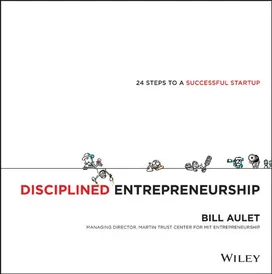
Disciplined Entrepreneurship
by Bill Aulet
Started 24 March 2020 · 288 pages
An MIT entrepreneurship course turned into a book: twenty-four steps to build a startup, from choosing a market segment to scaling, with an emphasis on the customer.
About the book, from Open Library. Get the book.
21 highlights · Kindle location in the margin
- 371
Many of the books I have found are excellent and have great material, including: Geoffrey Moore’s Crossing the Chasm, W. Chan Kim and Renée Mauborgne’s Blue Ocean Strategy, Brian Halligan and Dharmesh Shah’s Inbound Marketing, Steve Blank’s Four Steps to the Epiphany, Eric Ries’s The Lean Startup, Ash Maurya’s Running Lean, and Alex Osterwalder and Yves Pigneur’s Business Model Generation.
- 382
The goal of this book, then, is to provide guidance in a messy and sometimes confusing process where you, the entrepreneur, are attempting to do something that has never been done before. What a terribly difficult task to take on, but what an incredibly important one.
- 394
As someone once said to me, “In concept, concept and reality are the same, but in reality, concept and reality are not the same at all.
- 469
more important than being charismatic, entrepreneurs need to be effective communicators, recruiters, and salespeople.
- 496
The real reason why MIT is so successful at creating new companies is a combination of spirit and skills. At MIT there is a culture that encourages people to start companies all the time and everywhere, much like in Silicon Valley, Israel, Tech City in London, and Berlin today.
- 515
Entrepreneurship is about creating a new business where one did not exist before.
- 573
Innovation = Invention ∗ Commercialization
- 580
Google, which has made most of its money through AdWords, the text-based, keyword-driven advertisements on their search results pages. A different company, Overture, had invented such advertisements, but Google was successful through its commercialization of Overture’s invention.
- 583
the capability to commercialize an invention is necessary for real innovation. An entrepreneur, then, serves primarily as the commercialization agent.
- 593
As technology becomes more and more commoditized, you will see more business model innovations that leverage technology. There will still be many opportunities for technology-driven innovation in areas like energy storage, power electronics, wireless communications, and much more, but this is not the sole definition of innovation.
- 664
No matter how you have become interested in entrepreneurship, you need to start by first answering the following question: What can I do well that I would love to do for an extended period of time?
- 685
Often, you will find an idea or technology that improves something for you personally, then realize that idea or technology has the potential to help many others.
- 696
Your choice of co-founders is extremely important. The research at MIT suggests that businesses with multiple founders are more successful than those founded by an individual.
- 747
The single necessary and sufficient condition for a business is a paying customer. The day someone pays you money for your product or service, you have a business, and not a day before.
- 751
just because you have a paying customer does not mean you have a good business. In order to have a good, sustainable business, you will need to gain enough customers paying enough money within a relatively short period of time so you do not run out of capital, but instead, become profitable. And as a startup, you have few resources, so every action you take must be hyper-efficient.
- 758
Creating an innovative product where no market currently exists is essential to the success of a startup.
- 762
A target customer is a group of potential customers who share many characteristics and who would all have similar reasons to buy a particular product.
- 794
Take your resources and apply them to a narrow, carefully defined new market that you can dominate.
- 822
Even at this early stage, talking about your idea or technology with potential customers will give you clear and accurate feedback for your market segmentation. You will find them at trade shows, through connections with fellow students and professors (perhaps some of them would have been potential customers at their previous jobs), or, if others have heard about your idea or technology, perhaps they will be contacting you, suggesting potential uses. The best scenario is when you are the potential customer yourself and have a deep understanding of the problem you are trying to solve.
- 918
If there is already a market research report out there with all the information you need, it is probably too late for your new venture. You have missed the window of opportunity—someone else has beaten you to the market.
- 1203
It is better to avoid selecting the largest or very large markets, even if they seem like the “best” segments. The first market you attack will be a significant learning experience for you, so you are better off learning in a smaller market where you can quickly get high exposure among the base of potential customers.