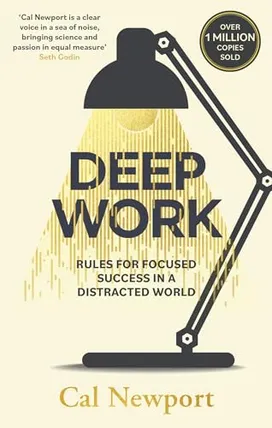
Deep Work
by Cal Newport
Started 24 October 2018 · 303 pages
Newport argues that the ability to focus without distraction on demanding work is rare and valuable, and gives rules for building deep work into a working life.
About the book, from Open Library. Get the book.
304 highlights · page in the margin
- p. 1
In 1922, the psychiatrist Carl Jung chose this spot to begin building a retreat. He began with a basic two-story stone house he called the Tower. After returning from a trip to India, where he observed the practice of adding meditation rooms to homes, he expanded the complex to include a private office.
- p. 3
Deep Work: Professional activities performed in a state of distraction-free concentration that push your cognitive capabilities to their limit. These efforts create new value, improve your skill, and are hard to replicate.
- p. 5
Microsoft CEO Bill Gates famously conducted “Think Weeks” twice a year, during which he would isolate himself (often in a lakeside cottage) to do nothing but read and think big thoughts.
- p. 5
Here’s how he once explained the omission: “If I organize my life in such a way that I get lots of long, consecutive, uninterrupted time-chunks, I can write novels. [If I instead get interrupted a lot] what replaces it? Instead of a novel that will be around for a long time … there is a bunch of e-mail messages that I have sent out to individual persons.”
- p. 5
The reason knowledge workers are losing their familiarity with deep work is well established: network tools. This is a broad category that captures communication services like e-mail and SMS, social media networks like Twitter and Facebook, and the shiny tangle of infotainment sites like BuzzFeed and Reddit.
- p. 6
A 2012 McKinsey study found that the average knowledge worker now spends more than 60 percent of the workweek engaged in electronic communication and Internet searching, with close to 30 percent of a worker’s time dedicated to reading and answering e-mail alone.
- p. 6
Shallow Work: Noncognitively demanding, logistical-style tasks, often performed while distracted. These efforts tend not to create much new value in the world and are easy to replicate.
- p. 6
Larger efforts that would be well served by deep thinking, such as forming a new business strategy or writing an important grant application, get fragmented into distracted dashes that produce muted quality.
- p. 7
To make matters worse for depth, there’s increasing evidence that this shift toward the shallow is not a choice that can be easily reversed. Spend enough time in a state of frenetic shallowness and you permanently reduce your capacity to perform deep work.
- p. 8
Our work culture’s shift toward the shallow (whether you think it’s philosophically good or bad) is exposing a massive economic and personal opportunity for the few who recognize the potential of resisting this trend and prioritizing depth—an opportunity that, not too long ago, was leveraged by a bored young consultant from Virginia named Jason Benn.
- p. 10
There were days during this period, he now admits, when he spent almost every minute (“98 percent of my time”) surfing the Web.
- p. 12
For someone who admitted to sometimes spending up to 98 percent of his day in his old job surfing the Web, Jason Benn’s transformation is nothing short of astonishing.
- p. 13
To succeed you have to produce the absolute best stuff you’re capable of producing—a task that requires depth.
- p. 13
In an industrial economy, there was a small skilled labor and professional class for which deep work was crucial, but most workers could do just fine without ever cultivating an ability to concentrate without distraction.
- p. 14
But as we shift to an information economy, more and more of our population are knowledge workers, and deep work is becoming a key currency—even if most haven’t yet recognized this reality.
- p. 14
Deep work is so important that we might consider it, to use the phrasing of business writer Eric Barker, “the superpower of the 21st century.”
- p. 14
We have now seen two strands of thought—one about the increasing scarcity of deep work and the other about its increasing value—which we can combine into the idea that provides the foundation for everything that follows in this book:
- p. 14
The Deep Work Hypothesis: The ability to perform deep work is becoming increasingly rare at exactly the same time it is becoming increasingly valuable in our economy. As a consequence, the few who cultivate this skill, and then make it the core of their working life, will thrive.
- p. 16
or any other social media presence outside of a blog. I don’t Web surf and get most of my news from my home-delivered Washington Post and NPR.
- p. 16
I build my days around a core of carefully chosen deep work, with the shallow activities I absolutely cannot avoid batched into smaller bursts at the peripheries of my schedule. Three to four hours a day, five days a week, of uninterrupted and carefully directed concentration, it turns out, can produce a lot of valuable output.
- p. 17
More generally, the lack of distraction in my life tones down that background hum of nervous mental energy that seems to increasingly pervade people’s daily lives. I’m comfortable being bored, and this can be a surprisingly rewarding skill—especially on a lazy D.C. summer night listening to a Nationals game slowly unfold on the radio.
- p. 22
The second type of answers are more macro in that they focus less on the individuals and more on the type of work they represent.
- p. 22
a pair of MIT economists, Erik Brynjolfsson and Andrew McAfee, who in their influential 2011 book, Race Against the Machine, provide a compelling case that among various forces at play, it’s the rise of digital technology in particular that’s transforming our labor markets in unexpected ways.
- p. 23
when only a human will do, improvements in communications and collaboration technology are making remote work easier than ever before, motivating companies to outsource key roles to stars—leaving the local talent pool underemployed.
- p. 23
In 2013, for example, the George Mason economist Tyler Cowen published Average Is Over, a book that echoes this thesis of a digital division. But what makes Brynjolfsson and McAfee’s analysis particularly useful is that they proceed to identify three specific groups that will fall on the lucrative side of this divide and reap a disproportionate amount of the benefits of the Intelligent Machine Age.
- p. 24
The High-Skilled Workers
- p. 24
Brynjolfsson and McAfee call the group personified by Nate Silver the “high-skilled” workers.
- p. 24
In other words, those with the oracular ability to work with and tease valuable results out of increasingly complex machines will thrive. Tyler Cowen summarizes this reality more bluntly: “The key question will be: are you good at working with intelligent machines or not?”
- p. 24
The Superstars
- p. 25
This same trend holds for the growing number of fields where technology makes productive remote work possible—consulting, marketing, writing, design, and so on. Once the talent market is made universally accessible, those at the peak of the market thrive while the rest suffer.
- p. 25
In a seminal 1981 paper, the economist Sherwin Rosen worked out the mathematics behind these “winner-take-all” markets.
- p. 25
a factor with “imperfect substitution,” which Rosen explains as follows: “Hearing a succession of mediocre singers does not add up to a single outstanding performance.” In other words, talent is not a commodity you can buy in bulk and combine to reach the needed levels: There’s a premium to being the best. Therefore, if you’re in a marketplace where the consumer has access to all performers, and everyone’s q value is clear, the consumer will choose the very best. Even if the talent advantage of the best is small compared to the next rung down on the skill ladder, the superstars still win the bulk of the market.
- p. 26
The Owners
- p. 27
As we’ve understood since Marx, access to capital provides massive advantages.
- p. 27
The Great Restructuring, unlike the postwar period, is a particularly good time to have access to capital.
- p. 27
bargaining theory, a key component in standard economic thinking, argues that when money is made through the combination of capital investment and labor, the rewards are returned, roughly speaking, proportional to the input. As digital technology reduces the need for labor in many industries, the proportion of the rewards returned to those who own the intelligent machines is growing.
- p. 28
In this new economy, three groups will have a particular advantage: those who can work well and creatively with intelligent machines, those who are the best at what they do, and those with access to capital.
- p. 28
How to Become a Winner in the New Economy
- p. 29
Two Core Abilities for Thriving in the New Economy
- p. 29
The ability to quickly master hard things. The ability to produce at an elite level, in terms of both quality and speed.
- p. 29
He instead maintains a large database of poll results (thousands of polls from more than 250 pollsters) that he feeds into Stata, a popular statistical analysis system produced by a company called StataCorp.
- p. 31
To join the group of those who can work well with these machines, therefore, requires that you hone your ability to master hard things. And because these technologies change rapidly, this process of mastering hard things never ends: You must be able to do it quickly, again and again.
- p. 31
To summarize these observations more succinctly: If you can’t learn, you can’t thrive.
- p. 31
If you want to become a superstar, mastering the relevant skills is necessary, but not sufficient. You must then transform that latent potential into tangible results that people value.
- p. 32
If you don’t produce, you won’t thrive—no matter how skilled or talented you are.
- p. 32
The two core abilities just described depend on your ability to perform deep work.
- p. 32
The dependence of these abilities on deep work isn’t immediately obvious; it requires a closer look at the science of learning, concentration, and productivity.
- p. 33
Antonin-Dalmace Sertillanges, a Dominican friar and professor of moral philosophy, who during the early part of the twentieth century penned a slim but influential volume titled The Intellectual Life. Sertillanges wrote the book as a guide to “the development and deepening of the mind” for those called to make a living in the world of ideas.
- p. 33
Sertillanges argues that to advance your understanding of your field you must tackle the relevant topics systematically, allowing your “converging rays of attention” to uncover the truth latent in each. In other words, he teaches: To learn requires intense concentration
- p. 35
To master a cognitively demanding task requires this specific form of practice—there are few exceptions made for natural talent.
- p. 35
Sertillanges seems to have been ahead of his time, arguing in The Intellectual Life, “Men of genius themselves were great only by bringing all their power to bear on the point on which they had decided to show their full measure.”
- p. 35
This brings us to the question of what deliberate practice actually requires. Its core components are usually identified as follows: (1) your attention is focused tightly on a specific skill you’re trying to improve or an idea you’re trying to master; (2) you receive feedback so you can correct your approach to keep your attention exactly where it’s most productive.
- p. 35
As Ericsson emphasizes, “Diffused attention is almost antithetical to the focused attention required by deliberate practice”
- p. 36
As the journalist Daniel Coyle surveys in his 2009 book, The Talent Code, these scientists increasingly believe the answer includes myelin—a layer of fatty tissue that grows around neurons, acting like an insulator that allows the cells to fire faster and cleaner. To understand the role of myelin in improvement, keep in mind that skills, be they intellectual or physical, eventually reduce down to brain circuits. This new science of performance argues that you get better at a skill as you develop more myelin around the relevant neurons, allowing the corresponding circuit to fire more effortlessly and effectively. To be great at something is to be well myelinated.
- p. 37
To learn hard things quickly, you must focus intensely without distraction.
- p. 39
They see productivity as a scientific problem to systematically solve—a
- p. 39
the batching of hard but important intellectual work into long, uninterrupted stretches.
- p. 40
(He typically divides the writing of a scholarly paper into three discrete tasks: analyzing the data, writing a full draft, and editing the draft into something publishable.)
- p. 40
In particular, by consolidating his work into intense and uninterrupted pulses, he’s leveraging the following law of productivity:
- p. 40
High-Quality Work Produced = (Time Spent) x (Intensity of Focus)
- p. 40
By maximizing his intensity when he works, he maximizes the results he produces per unit of time spent working.
- p. 41
Something I noticed in these interviews is that the very best students often studied less than the group of students right below them on the GPA rankings. One of the explanations for this phenomenon turned out to be the formula detailed earlier: The best students understood the role intensity plays in productivity and therefore went out of their way to maximize their concentration—radically reducing the time required to prepare for tests or write papers, without diminishing the quality of their results.
- p. 41
An interesting explanation comes from Sophie Leroy, a business professor at the University of Minnesota. In a 2009 paper, titled, intriguingly, “Why Is It So Hard to Do My Work?,” Leroy introduced an effect she called attention residue.
- p. 41
in the modern knowledge work office, once you got to a high enough level, it was more common to find people working on multiple projects sequentially:
- p. 42
The problem this research identifies with this work strategy is that when you switch from some Task A to another Task B, your attention doesn’t immediately follow—a residue of your attention remains stuck thinking about the original task. This residue gets especially thick if your work on Task A was unbounded and of low intensity before you switched, but even if you finish Task A before moving on, your attention remains divided for a while.
- p. 42
The results from this and her similar experiments were clear: “People experiencing attention residue after switching tasks are likely to demonstrate poor performance on that next task,” and the more intense the residue, the worse the performance.
- p. 43
By working on a single hard task for a long time without switching, Grant minimizes the negative impact of attention residue from his other obligations, allowing him to maximize performance on this one task.
- p. 44
To produce at your peak level you need to work for extended periods with full concentration on a single task free from distraction.
- p. 46
To ask a CEO to spend four hours thinking deeply about a single problem is a waste of what makes him or her valuable. It’s better to hire three smart subordinates to think deeply about the problem and then bring their solutions to the executive for a final decision.
- p. 52
In a well-cited study, Mark and her co-authors observed knowledge workers in real offices and found that an interruption, even if short, delays the total time required to complete a task by a significant fraction.
- p. 52
The respected New Yorker staff writer George Packer captured this fear well in an essay about why he does not tweet: “Twitter is crack for media addicts. It scares me, not because I’m morally superior to it, but because I don’t think I could handle it. I’m afraid I’d end up letting my son go hungry.”
- p. 54
He discovered that Atlantic Media was spending well over a million dollars a year to pay people to process e-mails, with every message sent or received tapping the company for around ninety-five cents of labor costs.
- p. 55
as knowledge work makes more complex demands of the labor force, it becomes harder to measure the value of an individual’s efforts.
- p. 56
The Principle of Least Resistance
- p. 58
The Principle of Least Resistance: In a business setting, without clear feedback on the impact of various behaviors to the bottom line, we will tend toward behaviors that are easiest in the moment.
- p. 61
Busyness as a Proxy for Productivity
- p. 61
Here, for example, is the late Nobel Prize–winning physicist Richard Feynman explaining in an interview one of his less orthodox productivity strategies: To do real good physics work, you do need absolute solid lengths of time … it needs a lot of concentration … if you have a job administrating anything, you don’t have the time. So I have invented another myth for myself: that I’m irresponsible. I’m actively irresponsible. I tell everyone I don’t do anything. If anyone asks me to be on a committee for admissions, “no,” I tell them: I’m irresponsible.
- p. 62
Matthew Crawford’s description of this uncertainty: “Managers themselves inhabit a bewildering psychic landscape, and are made anxious by the vague imperatives they must answer to.”
- p. 63
As Crawford describes in his 2009 ode to the trades, Shop Class as Soulcraft, he quit his job as a Washington, D.C., think tank director to open a motorcycle repair shop exactly to escape this bewilderment. The feeling of taking a broken machine, struggling with it, then eventually enjoying a tangible indication that he had succeeded (the bike driving out of the shop under its own power) provides a concrete sense of accomplishment he struggled to replicate when his day revolved vaguely around reports and communications strategies.
- p. 63
A similar reality creates problems for many knowledge workers. They want to prove that they’re productive members of the team and are earning their keep, but they’re not entirely clear what this goal constitutes. They have no rising h-index or rack of repaired motorcycles to point to as evidence of their worth. To overcome this gap, many seem to be turning back to the last time when productivity was more universally observable: the industrial age.
- p. 63
with the rise of assembly lines came the rise of the Efficiency Movement, identified with its founder, Frederic Taylor, who would famously stand with a stopwatch monitoring the efficiency of worker movements—looking for ways to increase the speed at which they accomplished their tasks.
- p. 64
Busyness as Proxy for Productivity: In the absence of clear indicators of what it means to be productive and valuable in their jobs, many knowledge workers turn back toward an industrial indicator of productivity: doing lots of stuff in a visible manner.
- p. 65
Knowledge work is not an assembly line, and extracting value from information is an activity that’s often at odds with busyness, not supported by it.
- p. 67
New York University professor Neil Postman. Writing in the early 1990s, as the personal computer revolution first accelerated, Postman argued that our society was sliding into a troubling relationship with technology. We were, he noted, no longer discussing the trade-offs surrounding new technologies, balancing the new efficiencies against the new problems introduced. If it’s high-tech, we began to instead assume, then it’s good. Case closed.
- p. 67
He called such a culture a technopoly, and he didn’t mince words in warning against it. “Technopoly eliminates alternatives to itself in precisely the way Aldous Huxley outlined in Brave New World,” he argued in his 1993 book on the topic. “It does not make them illegal. It does not make them immoral. It does not even make them unpopular. It makes them invisible and therefore irrelevant.”
- p. 68
Evgeny Morozov. In his 2013 book, To Save Everything, Click Here, Morozov attempts to pull back the curtains on our technopolic obsession with “the Internet” (a term he purposefully places in scare quotes to emphasize its role as an ideology), saying: “It’s this propensity to view ‘the Internet’ as a source of wisdom and policy advice that transforms it from a fairly uninteresting set of cables and network routers into a seductive and exciting ideology—perhaps today’s uber-ideology.”
- p. 68
We no longer see Internet tools as products released by for-profit companies, funded by investors hoping to make a return, and run by twentysomethings who are often making things up as they go along. We’re instead quick to idolize these digital doodads as a signifier of progress and a harbinger of a (dare I say, brave) new world.
- p. 69
Deep work is at a severe disadvantage in a technopoly because it builds on values like quality, craftsmanship, and mastery that are decidedly old-fashioned and nontechnological.
- p. 76
Gallagher set out to better understand the role that attention—that is, what we choose to focus on and what we choose to ignore—plays in defining the quality of our life.
- p. 77
Our brains instead construct our worldview based on what we pay attention to. If you focus on a cancer diagnosis, you and your life become unhappy and dark, but if you focus instead on an evening martini, you and your life become more pleasant—even though the circumstances in both scenarios are the same.
- p. 77
In Rapt, Gallagher surveys the research supporting this understanding of the mind.
- p. 79
Such concentration hijacks your attention apparatus, preventing you from noticing the many smaller and less pleasant things that unavoidably and persistently populate our lives.
- p. 79
(The psychologist Mihaly Csikszentmihalyi, whom we’ll learn more about in the next section, explicitly identifies this advantage when he emphasizes the advantage of cultivating “concentration so intense that there is no attention left over to think about anything irrelevant, or to worry about problems.”)
- p. 79
This danger is especially pronounced in knowledge work, which due to its dependence on ubiquitous connectivity generates a devastatingly appealing buffet of distraction—most of which will, if given enough attention, leach meaning and importance from the world constructed by your mind.
- p. 81
Many knowledge workers spend most of their working day interacting with these types of shallow concerns. Even when they’re required to complete something more involved, the habit of frequently checking inboxes ensures that these issues remain at the forefront of their attention. Gallagher teaches us that this is a foolhardy way to go about your day, as it ensures that your mind will construct an understanding of your working life that’s dominated by stress, irritation, frustration, and triviality. The world represented by your inbox, in other words, isn’t a pleasant world to inhabit.
- p. 81
“Five years of reporting on attention have confirmed some home truths,” Gallagher reports. “[Among them is the notion that] ‘the idle mind is the devil’s workshop’ … when you lose focus, your mind tends to fix on what could be wrong with your life instead of what’s right.” A workday driven by the shallow, from a neurological perspective, is likely to be a draining and upsetting day, even if most of the shallow things that capture your attention seem harmless or fun.
- p. 83
Csikszentmihalyi’s work with ESM helped validate a theory he had been developing over the preceding decade: “The best moments usually occur when a person’s body or mind is stretched to its limits in a voluntary effort to accomplish something difficult and worthwhile.” Csikszentmihalyi calls this mental state flow (a term he popularized with a 1990 book of the same title).
- p. 84
Human beings, it seems, are at their best when immersed deeply in something challenging.
- p. 86
To build your working life around the experience of flow produced by deep work is a proven path to deep satisfaction.
- p. 86
In 2011, Dreyfus and Kelly published a book, All Things Shining, which explores how notions of sacredness and meaning have evolved throughout the history of human culture.
- p. 87
in the domain of the metaphysical this thinking stripped the world of the order and sacredness essential to creating meaning.
- p. 88
The task of a craftsman, they conclude, “is not to generate meaning, but rather to cultivate in himself the skill of discerning the meanings that are already there.” This frees the craftsman of the nihilism of autonomous individualism, providing an ordered world of meaning.
- p. 89
The Pragmatic Programmer, a well-regarded book in the computer programming field, makes this connection between code and old-style craftsmanship more directly by quoting the medieval quarry worker’s creed in its preface: “We who cut mere stones must always be envisioning cathedrals.”
- p. 95
The Eudaimonia Machine is a good example of this intersection. The machine, which takes its name from the ancient Greek concept of eudaimonia (a state in which you’re achieving your full human potential), turns out to be a building.
- p. 98
one of the main obstacles to going deep: the urge to turn your attention toward something more superficial.
- p. 99
Here’s the short version of what they found: People fight desires all day long. As Baumeister summarized in his subsequent book, Willpower (co-authored with the science writer John Tierney): “Desire turned out to be the norm, not the exception.”
- p. 100
You have a finite amount of willpower that becomes depleted as you use it.
- p. 100
The key to developing a deep work habit is to move beyond good intentions and add routines and rituals to your working life designed to minimize the amount of your limited willpower necessary to transition into and maintain a state of unbroken concentration.
- p. 101
Decide on Your Depth Philosophy
- p. 102
The Monastic Philosophy of Deep Work Scheduling
- p. 103
Knuth deploys what I call the monastic philosophy of deep work scheduling. This philosophy attempts to maximize deep efforts by eliminating or radically minimizing shallow obligations. Practitioners of the monastic philosophy tend to have a well-defined and highly valued professional goal that they’re pursuing, and the bulk of their professional success comes from doing this one thing exceptionally well. It’s this clarity that helps them eliminate the thicket of shallow concerns that tend to trip up those whose value proposition in the working world is more varied.
- p. 104
Knuth, for example, explains his professional goal as follows: “I try to learn certain areas of computer science exhaustively; then I try to digest that knowledge into a form that is accessible to people who don’t have time for such study.”
- p. 106
The Bimodal Philosophy of Deep Work Scheduling
- p. 108
Jung’s approach is what I call the bimodal philosophy of deep work. This philosophy asks that you divide your time, dedicating some clearly defined stretches to deep pursuits and leaving the rest open to everything else. During the deep time, the bimodal worker will act monastically—seeking intense and uninterrupted concentration. During the shallow time, such focus is not prioritized. This division of time between deep and open can happen on multiple scales. For example, on the scale of a week, you might dedicate a four-day weekend to depth and the rest to open time. Similarly, on the scale of a year, you might dedicate one season to contain most of your deep stretches (as many academics do over the summer or while on sabbatical).
- p. 110
The Rhythmic Philosophy of Deep Work Scheduling
- p. 110
Seinfeld continued by describing a specific technique he used to help maintain this discipline. He keeps a calendar on his wall. Every day that he writes jokes he crosses out the date on the calendar with a big red X. “After a few days you’ll have a chain,” Seinfeld said. “Just keep at it and the chain will grow longer every day. You’ll like seeing that chain, especially when you get a few weeks under your belt. Your only job next is to not break the chain.”
- p. 111
the rhythmic philosophy. This philosophy argues that the easiest way to consistently start deep work sessions is to transform them into a simple regular habit. The goal, in other words, is to generate a rhythm for this work that removes the need for you to invest energy in deciding if and when you’re going to go deep. The chain method is a good example of the rhythmic philosophy of deep work scheduling because it combines a simple scheduling heuristic (do the work every day), with an easy way to remind yourself to do the work: the big red Xs on the calendar.
- p. 111
Another common way to implement the rhythmic philosophy is to replace the visual aid of the chain method with a set starting time that you use every day for deep work. In much the same way that maintaining visual indicators of your work progress can reduce the barrier to entry for going deep, eliminating even the simplest scheduling decisions, such as when during the day to do the work, also reduces this barrier.
- p. 113
By supporting deep work with rock-solid routines that make sure a little bit gets done on a regular basis, the rhythmic scheduler will often log a larger total number of deep hours per year.
- p. 114
The Journalistic Philosophy of Deep Work Scheduling
- p. 115
I call this approach, in which you fit deep work wherever you can into your schedule, the journalist philosophy.
- p. 116
As I established in the opening to this rule, the ability to rapidly switch your mind from shallow to deep mode doesn’t come naturally. Without practice, such switches can seriously deplete your finite willpower reserves. This habit also requires a sense of confidence in your abilities—a conviction that what you’re doing is important and will succeed. This type of conviction is typically built on a foundation of existing professional accomplishment.
- p. 116
To write this book, for example, I had to take advantage of free stretches of time wherever they popped up. If my kids were taking a good nap, I’d grab my laptop and lock myself in the home office. If my wife wanted to visit her parents in nearby Annapolis on a weekend day, I’d take advantage of the extra child care to disappear to a quiet corner of their house to write. If a meeting at work was canceled, or an afternoon left open, I might retreat to one of my favorite libraries on campus to squeeze out a few hundred more words. And so on.
- p. 117
An often-overlooked observation about those who use their minds to create valuable things is that they’re rarely haphazard in their work habits.
- p. 118
There is a popular notion that artists work from inspiration—that there is some strike or bolt or bubbling up of creative mojo from who knows where … but I hope [my work] makes clear that waiting for inspiration to strike is a terrible, terrible plan. In fact, perhaps the single best piece of advice I can offer to anyone trying to do creative work is to ignore inspiration.
- p. 119
In a New York Times column on the topic, David Brooks summarizes this reality more bluntly: “[Great creative minds] think like artists but work like accountants.”
- p. 119
there are some general questions that any effective ritual must address:
- p. 119
• Where you’ll work and for how long.
- p. 120
difficult). If it’s possible to identify a location used only for depth—for instance, a conference room or quiet library—the positive effect can be even greater. (If you work in an open office plan, this need to find a deep work retreat becomes particularly important.)
- p. 120
• How you’ll work once you start to work.
- p. 120
Your ritual needs rules and processes to keep your efforts structured. For example, you might institute a ban on any Internet use, or maintain a metric such as words produced per twenty-minute interval to keep your concentration honed.
- p. 120
• How you’ll support your work.
- p. 121
Nietzsche said: “It is only ideas gained from walking that have any worth.”)
- p. 121
keep in mind that finding a ritual that sticks might require experimentation, so be willing to work at it. I assure you that the effort’s worth it: Once you’ve evolved something that feels right, the impact can be significant.
- p. 122
By leveraging a radical change to your normal environment, coupled perhaps with a significant investment of effort or money, all dedicated toward supporting a deep work task, you increase the perceived importance of the task. This boost in importance reduces your mind’s instinct to procrastinate and delivers an injection of motivation and energy.
- p. 125
In all of these examples, it’s not just the change of environment or seeking of quiet that enables more depth. The dominant force is the psychology of committing so seriously to the task at hand. To put yourself in an exotic location to focus on a writing project, or to take a week off from work just to think, or to lock yourself in a hotel room until you complete an important invention: These gestures push your deep goal to a level of mental priority that helps unlock the needed mental resources. Sometimes to go deep, you must first go big.
- p. 126
these open office designs are not embraced haphazardly. As Maria Konnikova reports in The New Yorker, when this concept first emerged, its goal was to “facilitate communication and idea flow.”
- p. 127
when you allow people to bump into each other smart collaborations and new ideas emerge—the theory of serendipitous creativity.
- p. 132
creativity. The key is to maintain both in a hub-and-spoke-style arrangement: Expose yourself to ideas in hubs on a regular basis, but maintain a spoke in which to work deeply on what you encounter.
- p. 133
This back-and-forth represents a collaborative form of deep work (common in academic circles) that leverages what I call the whiteboard effect. For some types of problems, working with someone else at the proverbial shared whiteboard can push you deeper than if you were working alone. The presence of the other party waiting for your next insight—be it someone physically in the same room or collaborating with you virtually—can short-circuit the natural instinct to avoid depth.
- p. 134
First, distraction remains a destroyer of depth. Therefore, the hub-and-spoke model provides a crucial template. Separate your pursuit of serendipitous encounters from your efforts to think deeply and build on these inspirations. You should try to optimize each effort separately, as opposed to mixing them together into a sludge that impedes both goals.
- p. 134
Second, even when you retreat to a spoke to think deeply, when it’s reasonable to leverage the whiteboard effect, do so. By working side by side with someone on a problem, you can push each other toward deeper levels of depth, and therefore toward the generation of more and more valuable output as compared to working alone.
- p. 135
There is, however, a lesser-known piece to this story. As Christensen recalls, Grove asked him during a break in this meeting, “How do I do this?” Christensen responded with a discussion of business strategy, explaining how Grove could set up a new business unit and so on. Grove cut him off with a gruff reply: “You are such a naïve academic. I asked you how to do it, and you told me what I should do. I know what I need to do. I just don’t know how to do it.”
- p. 135
As Christensen later explained, this division between what and how is crucial but is overlooked in the professional world. It’s often straightforward to identify a strategy needed to achieve a goal, but what trips up companies is figuring out how to execute the strategy once identified.
- p. 136
Discipline #1: Focus on the Wildly Important
- p. 136
As the authors of The 4 Disciplines of Execution explain, “The more you try to do, the less you actually accomplish.” They elaborate that execution should be aimed at a small number of “wildly important goals.”
- p. 137
For example, when I first began experimenting with 4DX, I set the specific important goal of publishing five high-quality peer-reviewed papers in the upcoming academic year.
- p. 137
Discipline #2: Act on the Lead Measures
- p. 137
Once you’ve identified a wildly important goal, you need to measure your success. In 4DX, there are two types of metrics for this purpose: lag measures and lead measures. Lag measures describe the thing you’re ultimately trying to improve.
- p. 138
Lead measures, on the other hand, “measure the new behaviors that will drive success on the lag measures.”
- p. 138
For an individual focused on deep work, it’s easy to identify the relevant lead measure: time spent in a state of deep work dedicated toward your wildly important goal.
- p. 139
Discipline #3: Keep a Compelling Scoreboard
- p. 139
when attempting to drive your team’s engagement toward your organization’s wildly important goal, it’s important that they have a public place to record and track their lead measures.
- p. 139
It also provides a reinforcing source of motivation. Once the team notices their success with a lead measure, they become invested in perpetuating this performance.
- p. 139
In my early experiments with 4DX, I settled on a simple but effective solution for implementing this scoreboard. I took a piece of card stock and divided it into rows, one for each week of the current semester. I then labeled each row with the dates of the week and taped it to the wall next to my computer monitor (where it couldn’t be ignored).
- p. 140
This served two purposes. First, it allowed me to connect, at a visceral level, accumulated deep work hours and tangible results. Second, it helped calibrate my expectations for how many hours of deep work were needed per result. This reality (which was larger than I first assumed) helped spur me to squeeze more such hours into each
- p. 140
Discipline #4: Create a Cadence of Accountability
- p. 140
The 4DX authors elaborate that the final step to help maintain a focus on lead measures is to put in place “a rhythm of regular and frequent meetings of any team that owns a wildly important goal.” During these meetings, the team members must confront their scoreboard, commit to specific actions to help improve the score before the next meeting, and describe what happened with the commitments they made at the last meeting.
- p. 141
I discuss and recommend the habit of a weekly review in which you make a plan for the workweek ahead (see Rule #4). During my experiments with 4DX, I used a weekly review to look over my scoreboard to celebrate good weeks, help understand what led to bad weeks, and most important, figure out how to ensure a good score for the days ahead. This led me to adjust my schedule to meet the needs of my lead measure—enabling significantly more deep work than if I had avoided such reviews altogether.
- p. 141
The 4DX framework is based on the fundamental premise that execution is more difficult than strategizing.
- p. 141
As I noted earlier, when I first embraced 4DX I adopted the goal of publishing five peer-reviewed papers in the 2013–2014 academic year.
- p. 141
In retrospect, it was not so much the intensity of my deep work periods that increased, but instead their regularity. Whereas I used to cluster my deep thinking near paper submission deadlines, the 4DX habit kept my mind concentrated throughout the full year.
- p. 143
It’s important for our purposes to recognize that Kreider is no Thoreau. He didn’t retreat from the world of busyness to underscore a complicated social critique.
- p. 143
As a writer and artist, however, Kreider is instead concerned with deep work—the serious efforts that produce things the world values. These efforts, he’s convinced, need the support of a mind regularly released to leisure.
- p. 144
want to suggest a more applicable but still quite powerful heuristic: At the end of the workday, shut down your consideration of work issues until the next morning—no after-dinner e-mail check, no mental replays of conversations, and no scheming about how you’ll handle an upcoming challenge; shut down work thinking completely. If you need more time, then extend your workday, but once you shut down, your mind must be left free to encounter Kreider’s buttercups, stink bugs, and stars.
- p. 144
it’s worth taking the time to also understand the science behind the value of downtime.
- p. 144
Reason #1: Downtime Aids Insights
- p. 145
Dijksterhuis and his collaborators to introduce unconscious thought theory (UTT)—an attempt to understand the different roles conscious and unconscious deliberation play in decision making. At a high level, this theory proposes that for decisions that require the application of strict rules, the conscious mind must be involved. For example, if you need to do a math calculation, only your conscious mind is able to follow the precise arithmetic rules needed for correctness. On the other hand, for decisions that involve large amounts of information and multiple vague, and perhaps even conflicting, constraints, your unconscious mind is well suited to tackle the issue.
- p. 146
The implication of this line of research is that providing your conscious brain time to rest enables your unconscious mind to take a shift sorting through your most complex professional challenges. A shutdown habit, therefore, is not necessarily reducing the amount of time you’re engaged in productive work, but is instead diversifying the type of work you deploy.
- p. 146
Reason #2: Downtime Helps Recharge the Energy Needed to Work Deeply
- p. 147
attention restoration theory (ART), which claims that spending time in nature can improve your ability to concentrate. This theory, which was first proposed in the 1980s by the University of Michigan psychologists Rachel Kaplan and Stephen Kaplan (the latter of which co-authored the 2008 study discussed here, along with Marc Berman and John Jonides), is based on the concept of attention fatigue. To concentrate requires what ART calls directed attention. This resource is finite: If you exhaust it, you’ll struggle to concentrate. (For our purposes, we can think of this resource as the same thing as Baumeister’s limited willpower reserves we discussed in the introduction to this rule.*)
- p. 148
when walking through nature, you’re freed from having to direct your attention, as there are few challenges to navigate (like crowded street crossings), and experience enough interesting stimuli to keep your mind sufficiently occupied to avoid the need to actively aim your attention. This state allows your directed attention resources time to replenish. After fifty minutes of such replenishment, the subjects enjoyed a boost in their concentration.
- p. 148
What’s important to our purpose is observing that the implications of ART expand beyond the benefits of nature. The core mechanism of this theory is the idea that you can restore your ability to direct your attention if you give this activity a rest. Walking in nature provides such a mental respite, but so, too, can any number of relaxing activities so long as they provide similar “inherently fascinating stimuli” and freedom from directed concentration.
- p. 148
Having a casual conversation with a friend, listening to music while making dinner, playing a game with your kids, going for a run—the types of activities that will fill your time in the evening if you enforce a work shutdown—play the same attention-restoring role as walking in nature.
- p. 149
Reason #3: The Work That Evening Downtime Replaces Is Usually Not That Important
- p. 149
In Ericsson’s seminal 1993 paper on the topic, titled “The Role of Deliberate Practice in the Acquisition of Expert Performance,” he dedicates a section to reviewing what the research literature reveals about an individual’s capacity for cognitively demanding work. Ericsson notes that for a novice, somewhere around an hour a day of intense concentration seems to be a limit, while for experts this number can expand to as many as four hours—but rarely more.
- p. 151
To succeed with this strategy, you must first accept the commitment that once your workday shuts down, you cannot allow even the smallest incursion of professional concerns into your field of attention. This includes, crucially, checking e-mail, as well as browsing work-related websites. In both cases, even a brief intrusion of work can generate a self-reinforcing stream of distraction that impedes the shutdown advantages described earlier for a long time to follow
- p. 151
Another key commitment for succeeding with this strategy is to support your commitment to shutting down with a strict shutdown ritual that you use at the end of the workday to maximize the probability that you succeed.
- p. 151
In more detail, this ritual should ensure that every incomplete task, goal, or project has been reviewed and that for each you have confirmed that either (1) you have a plan you trust for its completion, or (2) it’s captured in a place where it will be revisited when the time is right. The process should be an algorithm: a series of steps you always conduct, one after another. When you’re done, have a set phrase you say that indicates completion (to end my own ritual, I say, “Shutdown complete”). This final step…
- p. 151
To make this suggestion more concrete, let me walk through the steps of my own shutdown ritual (which I first developed around the time I was writing my doctoral dissertation, and have deployed, in one form or another, ever since). The first thing I do is take a final look at my e-mail inbox to ensure that there’s nothing requiring an urgent response before the day ends. The next thing I do is transfer any new tasks that are on my mind or were scribbled down earlier in the day into my official task lists. (I use Google Docs for storing my task lists, as I like the ability to access them from any computer—but the technology here isn’t really relevant.) Once I have these task lists open, I quickly skim every task in every list, and then look at the next few days on my calendar. These two actions ensure that there’s nothing urgent I’m forgetting or any important deadlines or appointments sneaking up on me. I have, at this…
- p. 152
the Zeigarnik effect. This effect, which is named for the experimental work of the early-twentieth-century psychologist Bluma Zeigarnik, describes the ability of incomplete tasks to dominate our attention. It tells us that if you simply stop whatever you are doing at five p.m. and declare, “I’m done with work until tomorrow,” you’ll likely struggle to keep your mind clear of professional issues, as the many obligations left unresolved in your mind will, as in…
- p. 153
Fortunately, we don’t need to complete a task to get it off our minds. Riding to our rescue in this matter is our friend from earlier in the rule, the psychologist Roy Baumeister, who wrote a paper with E.J. Masicampo playfully titled “Consider It Done!” In this study, the two researchers began by replicating the Zeigarnik effect in their subjects (in this case, the researchers assigned a task and then cruelly engineered interruptions), but then found that they could significantly reduce the effect’s impact by asking the subjects, soon after the interruption, to make a plan for how they would later complete the incomplete task. To quote the…
- p. 154
From my experience, it should take a week or two before the shutdown habit sticks—that is, until your mind trusts your ritual enough to actually begin to release work-related thoughts in the evening. But once it does stick, the ritual will become a permanent fixture in your life—to the point that skipping the routine will fill you with a sense of unease.
- p. 157
The ability to concentrate intensely is a skill that must be trained.
- p. 158
We can find evidence for this claim in the research of Clifford Nass, the late Stanford communications professor who was well known for his study of behavior in the digital age. Among other insights, Nass’s research revealed that constant attention switching online has a lasting negative effect on your brain.
- p. 158
Once your brain has become accustomed to on-demand distraction, Nass discovered, it’s hard to shake the addiction even when you want to concentrate.
- p. 159
Don’t Take Breaks from Distraction. Instead Take Breaks from Focus.
- p. 160
Once you’re wired for distraction, you crave it.
- p. 161
Instead of scheduling the occasional break from distraction so you can focus, you should instead schedule the occasional break from focus to give in to distraction.
- p. 161
To make this suggestion more concrete, let’s make the simplifying assumption that Internet use is synonymous with seeking distracting stimuli.
- p. 161
Similarly, let’s consider working in the absence of the Internet to be synonymous with more focused work.
- p. 161
Schedule in advance when you’ll use the Internet, and then avoid it altogether outside these times. I suggest that you keep a notepad near your computer at work. On this pad, record the next time you’re allowed to use the Internet. Until you arrive at that time, absolutely no network connectivity is allowed—no matter how tempting.
- p. 161
The idea motivating this strategy is that the use of a distracting service does not, by itself, reduce your brain’s ability to focus. It’s instead the constant switching from low-stimuli/high-value activities to high-stimuli/low-value activities, at the slightest hint of boredom or cognitive challenge, that teaches your mind to never tolerate an absence of novelty. This constant switching can be understood analogously as weakening the mental muscles responsible for organizing the many sources vying for your attention. By segregating Internet use (and therefore segregating distractions) you’re minimizing the number of times you give in to distraction, and by doing so you let these attention-selecting muscles strengthen.
- p. 162
Point #1: This strategy works even if your job requires lots of Internet use and/or prompt e-mail replies.
- p. 163
Point #2: Regardless of how you schedule your Internet blocks, you must keep the time outside these blocks absolutely free from Internet use.
- p. 164
Point #3: Scheduling Internet use at home as well as at work can further improve your concentration training.
- p. 165
The key here isn’t to avoid or even to reduce the total amount of time you spend engaging in distracting behavior, but is instead to give yourself plenty of opportunities throughout your evening to resist switching to these distractions at the slightest hint of boredom.
- p. 165
One place where this strategy becomes particularly difficult outside work is when you’re forced to wait (for example, standing in line at a store). It’s crucial in these situations that if you’re in an offline block, you simply gird yourself for the temporary boredom, and fight through it with only the company of your thoughts. To simply wait and be bored has become a novel experience in modern life, but from the perspective of concentration training, it’s incredibly valuable.
- p. 169
After a few months of deploying this strategy, your understanding of what it means to focus will likely be transformed as you reach levels of intensity stronger than anything you’ve experienced before.
- p. 170
productive meditation.
- p. 170
The goal of productive meditation is to take a period in which you’re occupied physically but not mentally—walking, jogging, driving, showering—and focus your attention on a single well-defined professional problem. Depending on your profession, this problem might be outlining an article, writing a talk, making progress on a proof, or attempting to sharpen a business strategy. As in mindfulness meditation, you must continue to bring your attention back to the problem at hand when it wanders or stalls.
- p. 171
you might even consider scheduling a walk during your workday specifically for the purpose of applying productive meditation to your most pressing problem at the moment.
- p. 171
By forcing you to resist distraction and return your attention repeatedly to a well-defined problem, it helps strengthen your distraction-resisting muscles, and by forcing you to push your focus deeper and deeper on a single problem, it sharpens your concentration.
- p. 171
To succeed with productive meditation, it’s important to recognize that, like any form of meditation, it requires practice to do well.
- p. 171
When I first attempted this strategy, back in the early weeks of my postdoc, I found myself hopelessly distracted—ending long stretches of “thinking” with little new to show for my efforts. It took me a dozen or so sessions before I began to experience real results. You should expect something similar, so patience will be necessary.
- p. 172
Suggestion #1: Be Wary of Distractions and Looping
- p. 172
When you notice your attention slipping away from the problem at hand, gently remind yourself that you can return to that thought later, then redirect your attention back.
- p. 173
Suggestion #2: Structure Your Deep Thinking
- p. 173
variables. In the book chapter example, this next-step question might be, “How am I going to effectively open this chapter?,”
- p. 174
In 2006, the American science writer Joshua Foer won the USA Memory Championship after only a year of (intense) training—a journey he chronicled in his 2011 bestseller, Moonwalking with Einstein.
- p. 175
“We found that one of the biggest differences between memory athletes and the rest of us is in a cognitive ability that’s not a direct measure of memory at all but of attention,” explained Roediger in a New York Times blog post (emphasis mine). The ability in question is called “attentional control,” and it measures the subjects’ ability to maintain their focus on essential information.
- p. 175
A side effect of memory training, in other words, is an improvement in your general ability to concentrate. This ability can then be fruitfully applied to any task demanding deep work.
- p. 184
This rule attempts to break us out of this rut by proposing a third option: accepting that these tools are not inherently evil, and that some of them might be quite vital to your success and happiness, but at the same time also accepting that the threshold for allowing a site regular access to your time and attention (not to mention personal data) should be much more stringent, and that most people should therefore be using many fewer such tools.
- p. 186
The Any-Benefit Approach to Network Tool Selection: You’re justified in using a network tool if you can identify any possible benefit to its use, or anything you might possibly miss out on if you don’t use it.
- p. 187
It’s here that we encounter the true insidious nature of an any-benefit mind-set. The use of network tools can be harmful. If you don’t attempt to weigh pros against cons, but instead use any glimpse of some potential benefit as justification for unrestrained use of a tool, then you’re unwittingly crippling your ability to succeed in the world of knowledge work.
- p. 190
This complexity underscores an important reality: The notion that identifying some benefit is sufficient to invest money, time, and attention in a tool is near laughable to people in his trade.
- p. 191
The Craftsman Approach to Tool Selection: Identify the core factors that determine success and happiness in your professional and personal life. Adopt a tool only if its positive impacts on these factors substantially outweigh its negative impacts.
- p. 193
Packer, for his part, worries about distraction, saying: “Twitter is crack for media addicts.” He goes so far as to describe Carr’s rave about the service as “the most frightening picture of the future that I’ve read thus far in the new decade.”
- p. 194
The first step of this strategy is to identify the main high-level goals in both your professional and your personal life. If you have a family, for example, then your personal goals might involve parenting well and running an organized household. In the professional sphere, the details of these goals depend on what you do for a living. In my own work as a professor, for example, I pursue two important goals, one centered on being an effective teacher in the classroom and effective mentor to my graduate students, and another centered on being an effective researcher.
- p. 195
Once you’ve identified these goals, list for each the two or three most important activities that help you satisfy the goal. These activities should be specific enough to allow you to clearly picture doing them. On the other hand, they should be general enough that they’re not tied to a onetime outcome.
- p. 195
A good activity in this context would be something like: “regularly read and understand the cutting-edge results in my field.”
- p. 195
The next step in this strategy is to consider the network tools you currently use. For each such tool, go through the key activities you identified and ask whether the use of the tool has a substantially positive impact, a substantially negative impact, or little impact on your regular and successful participation in the activity. Now comes the important decision: Keep using this tool only if you concluded that it has substantial positive impacts and that these outweigh the negative impacts.
- p. 197
In other words, the question is not whether Twitter has some conceivable benefit to Lewis; it’s instead whether Twitter use significantly and positively affects the most important activities in his professional life.
- p. 197
Imagine that our hypothetical author diligently sends ten individualized tweets a day, five days a week—each of which connects one-on-one with a new potential reader.
- p. 197
The question once again is not whether Twitter offers some benefits, but instead whether it offers enough benefits to offset its drag on your time and attention (two resources that are especially valuable to a writer).
- p. 198
Personal Goal: To maintain close and rewarding friendships with a group of people who are important to me. Key Activities Supporting This Goal: Regularly take the time for meaningful connection with those who are most important to me (e.g., a long talk, a meal, joint activity). Give of myself to those who are most important to me (e.g., making nontrivial sacrifices that improve their lives).
- p. 201
The Law of the Vital Few*: In many settings, 80 percent of a given effect is due to just 20 percent of the possible causes.
- p. 201
might be the case that 80 percent of a business’s profits come from just 20 percent of its clients, 80 percent of a nation’s wealth is held by its richest 20 percent of citizens, or 80 percent of computer software crashes come from just 20 percent of the identified bugs.
- p. 201
There’s a formal mathematical underpinning to this phenomenon (an 80/20 split is roughly what you would expect when describing a power law distribution over impact—a type of distribution that shows up often when measuring quantities in the real world), but it’s probably most useful when applied heuristically as a reminder that, in many cases, contributions to an outcome are not evenly distributed.
- p. 201
Moving forward, let’s assume that this law holds for the important goals in your life.
- p. 201
Assuming that you could probably list somewhere between ten and fifteen distinct and potentially beneficial activities for each of your life goals, this law says that it’s the top two or three such activities—the number that this strategy asks you to focus on—that make most of the difference in whether or not you succeed with the goal.
- p. 202
It’s a zero-sum game. And because your time returns substantially more rewards when invested in high-impact activities than when invested in low-impact activities, the more of it you shift to the latter, the lower your overall benefit.
- p. 202
The business world understands this math. This is why it’s not uncommon to see a company fire unproductive clients. If 80 percent of their profits come from 20 percent of their clients, then they make more money by redirecting the energy from low-revenue clients to better service the small number of lucrative contracts—each hour spent on the latter returns more revenue than each hour spent on the former.
- p. 202
By taking the time consumed by low-impact activities—like finding old friends on Facebook—and reinvesting in high-impact activities—like taking a good friend out to lunch—you end up more successful in your goal.
- p. 204
you’ll instead ban yourself from using them for thirty days. All of them: Facebook, Instagram, Google+, Twitter, Snapchat, Vine—or whatever other services have risen to popularity since I first wrote these words. Don’t formally deactivate these services, and (this is important) don’t mention online that you’ll be signing off: Just stop using them, cold turkey.
- p. 205
After thirty days of this self-imposed network isolation, ask yourself the following two questions about each of the services you temporarily quit: Would the last thirty days have been notably better if I had been able to use this service? Did people care that I wasn’t using this service?
- p. 205
This strategy picks specifically on social media because among the different network tools that can claim your time and attention, these services, if used without limit, can be particularly devastating to your quest to work deeper. They offer personalized information arriving on an unpredictable intermittent schedule—making them massively addictive and therefore capable of severely damaging your attempts to schedule and succeed with any act of concentration.
- p. 206
part of what makes social media insidious is that the companies that profit from your attention have succeeded with a masterful marketing coup: convincing our culture that if you don’t use their products you might miss out.
- p. 207
Speaking from experience as someone who makes a living trying to sell my ideas to people: This is a powerfully addictive feeling!
- p. 207
Part of what fueled social media’s rapid assent, I contend, is its ability to short-circuit this connection between the hard work of producing real value and the positive reward of having people pay attention to you. It has instead replaced this timeless capitalist exchange with a shallow collectivist alternative: I’ll pay attention to what you say if you pay attention to what I say—regardless of its value.
- p. 209
These services aren’t necessarily, as advertised, the lifeblood of our modern connected world. They’re just products, developed by private companies, funded lavishly, marketed carefully, and designed ultimately to capture then sell your personal information and attention to advertisers. They can be fun, but in the scheme of your life and what you want to accomplish, they’re a lightweight whimsy, one unimportant distraction among many threatening to derail you from something deeper.
- p. 211
the logical foundation of his proposal, that you both should and can make deliberate use of your time outside work, remains relevant today—especially with respect to the goal of this rule, which is to reduce the impact of network tools on your ability to perform deep work.
- p. 211
In more detail, in the strategies discussed so far in this rule, we haven’t spent much time yet on a class of network tools that are particularly relevant to the fight for depth: entertainment-focused websites designed to capture and hold your attention for as long as possible. At the time of this writing, the most popular examples of such sites include the Huffington Post, BuzzFeed, Business Insider, and Reddit.
- p. 212
These sites are especially harmful after the workday is over, where the freedom in your schedule enables them to become central to your leisure time.
- p. 212
Fortunately, Arnold Bennett identified the solution to this problem a hundred years earlier: Put more thought into your leisure time. In other words, this strategy suggests that when it comes to your relaxation, don’t default to whatever catches your attention at the moment, but instead dedicate some advance thinking to the question of how you want to spend your “day within a day.”
- p. 213
It’s crucial, therefore, that you figure out in advance what you’re going to do with your evenings and weekends before they begin. Structured hobbies provide good fodder for these hours, as they generate specific actions with specific goals to fill your time. A set program of reading, à la Bennett, where you spend regular time each night making progress on a series of deliberately chosen books, is also a good option, as is, of course, exercise or the enjoyment of good (in-person) company.
- p. 214
In my experience, this analysis is spot-on. If you give your mind something meaningful to do throughout all your waking hours, you’ll end the day more fulfilled, and begin the next one more relaxed, than if you instead allow your mind to bathe for hours in semiconscious and unstructured Web surfing.
- p. 214
Not only will this preserve your ability to resist distraction and concentrate, but you might even fulfill Arnold Bennett’s ambitious goal of experiencing, perhaps for the first time, what it means to live, and not just exist.
- p. 216
Very few people work even 8 hours a day. You’re lucky if you get a few good hours in between all the meetings, interruptions, web surfing, office politics, and personal business that permeate the typical workday.
- p. 218
The shallow work that increasingly dominates the time and attention of knowledge workers is less vital than it often seems in the moment. For most businesses, if you eliminated significant amounts of this shallowness, their bottom line would likely remain unaffected.
- p. 219
Deep work is exhausting because it pushes you toward the limit of your abilities.
- p. 220
even though we’re not capable of spending a full day in a state of blissful depth, this reality shouldn’t reduce the urgency of reducing shallow work, as the typical knowledge workday is more easily fragmented than many suspect.
- p. 221
Schedule Every Minute of Your Day
- p. 222
When you consider different groups self-estimating different behaviors, similar gaps stubbornly remain.
- p. 222
We spend much of our day on autopilot—not giving much thought to what we’re doing with our time. This is a problem. It’s difficult to prevent the trivial from creeping into every corner of your schedule if you don’t face, without flinching, your current balance between deep and shallow work, and then adopt the habit of pausing before action and asking, “What makes the most sense right now?”
- p. 222
Schedule every minute of your day.
- p. 223
At the beginning of each workday, turn to a new page of lined paper in a notebook you dedicate to this purpose. Down the left-hand side of the page, mark every other line with an hour of the day, covering the full set of hours you typically work. Now comes the important part: Divide the hours of your workday into blocks and assign activities to the blocks. For example, you might block off nine a.m. to eleven a.m. for writing a client’s press release. To do so, actually draw a box that covers the lines corresponding to these hours, then write “press release” inside the box. Not every block need be dedicated to a work task. There might be time blocks for lunch or relaxation breaks. To keep things reasonably clean, the minimum length of a block should be thirty minutes (i.e., one line on your page). This means, for example, that instead of having a unique small box for each small task on your plate for the day—respond to boss’s e-mail, submit reimbursement form, ask Carl about report—you can batch similar things into more generic task blocks. You might find it useful, in this case, to draw a line from a task block to the open right-hand side of the page where you can list out the full set of small tasks you plan to accomplish in that block.
- p. 223
When you’re done scheduling your day, every minute should be part of a block. You have, in effect, given every minute of your workday a job. Now as you go through your day, use this schedule to guide you.
- p. 224
Your goal is not to stick to a given schedule at all costs; it’s instead to maintain, at all times, a thoughtful say in what you’re doing with your time going forward—even if these decisions are reworked again and again as the day unfolds.
- p. 224
First, you should recognize that almost definitely you’re going to underestimate at first how much time you require for most things.
- p. 224
Over time, you should make an effort to accurately (if not somewhat conservatively) predict the time tasks will require.
- p. 225
The second tactic that helps is the use of overflow conditional blocks. If you’re not sure how long a given activity might take, block off the expected time, then follow this with an additional block that has a split purpose. If you need more time for the preceding activity, use this additional block to keep working on it. If you finish the activity on time, however, have an alternate use already assigned for the extra block (for example, some nonurgent tasks). This allows unpredictability in your day without requiring you to keep changing your schedule on paper.
- p. 225
The third tactic I suggest is to be liberal with your use of task blocks. Deploy many throughout your day and make them longer than required to handle the tasks you plan in the morning.
- p. 226
In my own daily scheduling discipline, in addition to regularly scheduling significant blocks of time for speculative thinking and discussion, I maintain a rule that if I stumble onto an important insight, then this is a perfectly valid reason to ignore the rest of my schedule for the day (with the exception, of course, of things that cannot be skipped). I can then stick with this unexpected insight until it loses steam. At this point, I’ll step back and rebuild my schedule for any time that remains in the day.
- p. 226
This type of scheduling, however, isn’t about constraint—it’s instead about thoughtfulness. It’s a simple habit that forces you to continually take a moment throughout your day and ask: “What makes sense for me to do with the time that remains?”
- p. 226
I would go so far as to argue that someone following this combination of comprehensive scheduling and a willingness to adapt or modify the plan as needed will likely experience more creative insights than someone who adopts a more traditionally “spontaneous” approach where the day is left open and unstructured.
- p. 227
because you’re willing to abandon your plan when an innovative idea arises, you’re just as well suited as the distracted creative to follow up when the muse strikes.
- p. 228
An advantage of scheduling your day is that you can determine how much time you’re actually spending in shallow activities.
- p. 228
Shallow Work: Noncognitively demanding, logistical-style tasks, often performed while distracted. These efforts tend not to create much new value in the world and are easy to replicate.
- p. 229
The purpose of this strategy is to give you an accurate metric for resolving such ambiguity—providing you with a way to make clear and consistent decisions about where given work tasks fall on the shallow-to-deep scale.
- p. 229
To do so, it asks that you evaluate activities by asking a simple (but surprisingly illuminating) question: How long would it take (in months) to train a smart recent college graduate with no specialized training in my field to complete this task?
- p. 231
tasks that leverage your expertise tend to be deep tasks and they can therefore provide a double benefit: They return more value per time spent, and they stretch your abilities, leading to improvement.
- p. 232
Ask Your Boss for a Shallow Work Budget
- p. 232
What percentage of my time should be spent on shallow work?
- p. 232
If you have a boss, in other words, have a conversation about this question. (You’ll probably have to first define for him or her what “shallow” and “deep” work means.) If you work for yourself, ask yourself this question. In both cases, settle on a specific answer. Then—and this is the important part—try to stick to this budget.
- p. 233
Obeying this budget will likely require changes to your behavior. You’ll almost certainly end up forced into saying no to projects that seem infused with shallowness while also more aggressively reducing the amount of shallowness in your existing projects.
- p. 233
This budget might lead you to drop the need for a weekly status meeting in preference for results-driven reporting (“let me know when you’ve made significant progress; then we’ll talk”). It might also lead you to start spending more mornings in communication isolation or decide it’s not as important as you once thought to respond quickly and in detail to every cc’d e-mail that crosses your inbox.
- p. 233
This limit frees up space for significant amounts of deep effort on a consistent basis.
- p. 234
As I discussed in Chapter 2, part of the reason shallow work persists in large quantities in knowledge work is that we rarely see the total impact of such efforts on our schedules.
- p. 234
in the end, a business’s goal is to generate value, not to make sure its employees’ lives are as easy as possible.
- p. 234
If you work for yourself, this exercise will force you to confront the reality of how little time in your “busy” schedule you’re actually producing value.
- p. 235
By instead picking and sticking with a shallow-to-deep ratio, you can replace this guilt-driven unconditional acceptance with the more healthy habit of trying to get the most out of the time you put aside for shallow work (therefore still exposing yourself to many opportunities), but keeping these efforts constrained to a small enough fraction of your time and attention to enable the deep work that ultimately drives your business forward.
- p. 235
a boss might reply, in so many words, “as much shallow work as is needed for you to promptly do whatever we need from you at the moment.” In this case, the answer is still useful, as it tells you that this isn’t a job that supports deep work, and a job that doesn’t support deep work is not a job that can help you succeed in our current information economy. You should, in this case, thank the boss for the feedback, and then promptly start planning how you can transition into a new position that values depth.
- p. 236
p.m. I call this commitment fixed-schedule productivity, as I fix the firm goal of not working past a certain time, then work backward to find productivity strategies that allow me to satisfy this declaration.
- p. 238
According to her article, one of the main techniques for respecting her hour limit was to set drastic quotas on the major sources of shallow endeavors in her academic life.
- p. 239
I, too, am incredibly cautious about my use of the most dangerous word in one’s productivity vocabulary: “yes.”
- p. 240
The Damoclean cap on the workday enforced by fixed-schedule productivity has a way of keeping my organization efforts sharp.
- p. 240
First, we’re asymmetric in the culling forced by our fixed-schedule commitment. By ruthlessly reducing the shallow while preserving the deep, this strategy frees up our time without diminishing the amount of new value we generate.
- p. 240
Second, the limits to our time necessitate more careful thinking about our organizational habits, also leading to more value produced as compared to longer but less organized schedules.
- p. 241
Fixed-schedule productivity, in other words, is a meta-habit that’s simple to adopt but broad in its impact. If you have to choose just one behavior that reorients your focus toward the deep, this one should be high on your list of possibilities.
- p. 243
Tip #1: Make People Who Send You E-mail Do More Work
- p. 244
The default social convention surrounding e-mail is that unless you’re famous, if someone sends you something, you owe him or her a response.
- p. 246
Consider consultant Clay Herbert, who is an expert in running crowd-funding campaigns for technology start-ups: a specialty that attracts a lot of correspondents hoping to glean some helpful advice.
- p. 248
Tip #2: Do More Work When You Send or Reply to E-mails
- p. 249
What is the project represented by this message, and what is the most efficient (in terms of messages generated) process for bringing this project to a successful conclusion?
- p. 252
Second, to steal terminology from David Allen, a good process-centric message immediately “closes the loop” with respect to the project at hand. When a project is initiated by an e-mail that you send or receive, it squats in your mental landscape—becoming something that’s “on your plate” in the sense that it has been brought to your attention and eventually needs to be addressed. This method closes this open loop as soon as it forms.
- p. 253
Tip #3: Don’t Respond
- p. 255
Professorial E-mail Sorting: Do not reply to an e-mail message if any of the following applies: It’s ambiguous or otherwise makes it hard for you to generate a reasonable response. It’s not a question or proposal that interests you. Nothing really good would happen if you did respond and nothing really bad would happen if you didn’t.
- p. 256
There are two common tropes bandied around when people discuss solutions to e-mail overload. One says that sending e-mails generates more e-mails, while the other says that wrestling with ambiguous or irrelevant e-mails is a major source of inbox-related stress. The approach suggested here responds aggressively to both issues—you send fewer e-mails and ignore those that aren’t easy to process—and by doing so will significantly weaken the grip your inbox maintains over your time and attention.
- p. 258
is instead a pragmatic recognition that the ability to concentrate is a skill that gets valuable things done.
- p. 261
I had applied and been rejected for a well-respected grant that many of my colleagues were receiving. I was upset and embarrassed, so I decided that instead of just complaining or wallowing in self-doubt, I would compensate for losing the grant by increasing the rate and impressiveness of my publications—allowing them to declare on my behalf that I actually did know what I was doing, even if this one particular grant application didn’t go my way.
- p. 261
I placed a tally of my deep work hours in a prominent position near my desk and got upset when it failed to grow at a fast enough rate.
- p. 262
Whereas earlier, I tended to increase my deep work only as a deadline approached, this year I was relentless—most every day of most every week I was pushing my mind to grapple with results of consequence, regardless of whether or not a specific deadline was near. I solved proofs on subway rides and while shoveling snow. When my son napped on the weekend, I would pace the yard thinking, and when stuck in traffic I would methodically work through problems that were stymieing me.
- p. 264
There’s also an uneasiness that surrounds any effort to produce the best things you’re capable of producing, as this forces you to confront the possibility that your best is not (yet) that good.