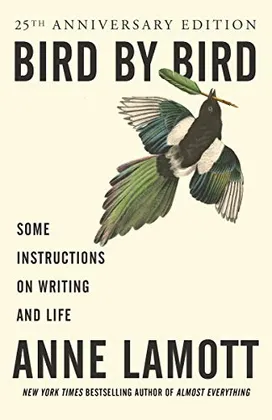
Bird by Bird
by Anne Lamott
Started 18 September 2020 · 239 pages
Lamott’s funny, honest guide to the writing life: shitty first drafts, short assignments, perfectionism, jealousy, and why writing teaches you how to pay attention.
About the book, from Open Library. Get the book.
112 highlights · Kindle location in the margin
- 65
I grew up around a father and a mother who read every chance they got, who took us to the library every Thursday night to load up on books for the coming week. Most nights after dinner my father stretched out on the couch to read, while my mother sat with her book in the easy chair and the three of us kids each retired to our own private reading stations.
- 79
One of the gifts of being a writer is that it gives you an excuse to do things, to go places and explore. Another is that writing motivates you to look closely at life, at life as it lurches by and tramps around.
- 82
He taught the prisoners and me to put a little bit down on paper every day, and to read all the great books and plays we could get our hands on.
- 84
Thurber was right when he said, “You might as well fall flat on your face as lean over too far backwards.”
- 88
I was very shy and strange-looking, loved reading above everything else, weighed about forty pounds at the time, and was so tense that I walked around with my shoulders up to my ears, like Richard Nixon.
- 100
I understood immediately the thrill of seeing oneself in print. It provides some sort of primal verification: you are in print; therefore you exist.
- 103
Seeing yourself in print is such an amazing concept: you can get so much attention without having to actually show up somewhere. While others who have something to say or who want to be effectual, like musicians or baseball players or politicians, have to get out there in front of people, writers, who tend to be shy, get to stay home and still be public. There are many obvious advantages to this. You don’t have to dress up, for instance, and you can’t hear them boo you right away.
- 120
All I ever wanted was to belong, to wear that hat of belonging.
- 147
“This is the great tragedy of California,” he wrote in the last paragraph, “for a life oriented to leisure is in the end a life oriented to death—the greatest leisure of all.”
- 154
Later that summer I came to know how they felt, when I read Catcher in the Rye for the first time and knew what it was like to have someone speak for me, to close a book with a sense of both triumph and relief, one lonely isolated social animal finally making contact.
- 162
He could take major events or small episodes from daily life and shade or exaggerate things in such a way as to capture their shape and substance, capture what life felt like in the society in which he and his friends lived and worked and bred. People looked to him to put into words what was going on.
- 164
I suspect that he was a child who thought differently than his peers, who may have had serious conversations with grown-ups, who as a young person, like me, accepted being alone quite a lot.
- 166
Throughout my childhood I believed that what I thought about was different from what other kids thought about. It was not necessarily more profound, but there was a struggle going on inside me to find some sort of creative or spiritual or aesthetic way of seeing the world and organizing it in my head. I read more than other kids; I luxuriated in books. Books were my refuge. I sat in corners with my little finger hooked over my bottom lip, reading, in a trance, lost in the places and times to which books took me.
- 177
I was drawn to oddballs, ethnic people, theater people, poets, radicals, gays and lesbians—and somehow they all helped me become some of those things I wanted so desperately to become: political, intellectual, artistic.
- 190
“Do it every day for a while,” my father kept saying. “Do it as you would do scales on the piano. Do it by prearrangement with yourself. Do it as a debt of honor. And make a commitment to finishing things.”
- 232
major reviewers would proclaim that not since Moby Dick had an American novel so captured life in all of its dizzying complexity.
- 236
Writing has so much to give, so much to teach, so many surprises. That thing you had to force yourself to do—the actual act of writing—turns out to be the best part. It’s like discovering that while you thought you needed the tea ceremony for the caffeine, what you really needed was the tea ceremony. The act of writing turns out to be its own reward.
- 269
So God made some of us fast in this area of working with words, and he gave us the gift of loving to read with the same kind of passion with which we love nature. My students at the writing workshops have this gift of loving to read, and some of them are really fast, really good with words, and some of them aren’t really fast and don’t write all that well, but they still love good writing, and they just want to write. And I say, “Hey! That is good enough for me. Come on down.”
- 275
I tell them they’ll want to be really good right off, and they may not be, but they might be good someday if they just keep the faith and keep practicing. And they may even go from wanting to have written something to just wanting to be writing, wanting to be working on something, like they’d want to be playing the piano or tennis, because writing brings with it so much joy, so much challenge. It is work and play together. When they are working on their books or stories, their heads will spin with ideas and invention. They’ll see the world through new eyes. Everything they see and hear and learn will become grist for the mill. At cocktail parties or in line at the post office, they will be gleaning small moments and overheard expressions: they’ll sneak away to scribble these things down. They will have days at the desk of frantic boredom, of angry hopelessness, of wanting to quit forever, and there will be days when it feels like they have caught and are riding a wave.
- 297
sometimes when my writer friends are working, they feel better and more alive than they do at any other time. And sometimes when they are writing well, they feel that they are living up to something. It is as if the right words, the true words, are already inside them, and they just want to help them get out. Writing this way is a little like milking a cow: the milk is so rich and delicious, and the cow is so glad you did it.
- p. 3
good writing is about telling the truth. We are a species that needs and wants to understand who we are.
- p. 4
Flannery O’Connor said that anyone who survived childhood has enough material to write for the rest of his or her life.
- p. 4
you might start by writing down every single thing you can remember from your first few years in school. Start with kindergarten. Try to get the words and memories down as they occur to you. Don’t worry if what you write is no good, because no one is going to see it. Move on to first grade, to second, to third. Who were your teachers, your classmates? What did you wear? Who and what were you jealous of? Now branch out a little. Did your family take vacations during those years? Get these down on paper. Do you remember how much more presentable everybody else’s family looked? Do you remember how when you’d be floating around in an inner tube on a river, your own family would have lost the little cap that screws over the airflow valve, so every time you got in and out of the inner tube, you’d scratch new welts in your thighs? And how other families never lost the caps?
- p. 6
You sit down, I say. You try to sit down at approximately the same time every day. This is how you train your unconscious to kick in for you creatively. So you sit down at, say, nine every morning, or ten every night. You put a piece of paper in the typewriter, or you turn on your computer and bring up the right file, and then you stare at it for an hour or so.
- p. 9
becoming a better writer is going to help you become a better reader, and that is the real payoff.
- p. 12
The problem that comes up over and over again is that these people want to be published. They kind of want to write, but they really want to be published. You’ll never get to where you want to be that way, I tell them. There is a door we all want to walk through, and writing can help you find it and open it.
- p. 13
What’s real is that if you do your scales every day, if you slowly try harder and harder pieces, if you listen to great musicians play music you love, you’ll get better.
- p. 17
E. L. Doctorow once said that “writing a novel is like driving a car at night. You can see only as far as your headlights, but you can make the whole trip that way.” You don’t have to see where you’re going, you don’t have to see your destination or everything you will pass along the way. You just have to see two or three feet ahead of you. This is right up there with the best advice about writing, or life, I have ever heard.
- p. 17
I remember to pick up the one-inch picture frame and to figure out a one-inch piece of my story to tell, one small scene, one memory, one exchange.
- p. 18
hope, as Chesterton said, is the power of being cheerful in circumstances that we know to be desperate. Writing can be a pretty desperate endeavor, because it is about some of our deepest needs: our need to be visible, to be heard, our need to make sense of our lives, to wake up and grow and belong.
- p. 18
Look, honey, all we’re going to do for now is to write a description of the river at sunrise, or the young child swimming in the pool at the club, or the first time the man sees the woman he will marry. That is all we are going to do for now. We are just going to take this bird by bird. But we are going to finish this one short assignment.
- p. 21
Very few writers really know what they are doing until they’ve done it. Nor do they go about their business feeling dewy and thrilled. They do not type a few stiff warm-up sentences and then find themselves bounding along like huskies across the snow.
- p. 24
Almost all good writing begins with terrible first efforts. You need to start somewhere. Start by getting something—anything—down on paper. A friend of mine says that the first draft is the down draft—you just get it down. The second draft is the up draft—you fix it up. You try to say what you have to say more accurately. And the third draft is the dental draft, where you check every tooth, to see if it’s loose or cramped or decayed, or even, God help us, healthy.
- p. 25
Close your eyes and get quiet for a minute, until the chatter starts up. Then isolate one of the voices and imagine the person speaking as a mouse. Pick it up by the tail and drop it into a mason jar. Then isolate another voice, pick it up by the tail, drop it in the jar. And so on. Drop in any high-maintenance parental units, drop in any contractors, lawyers, colleagues, children, anyone who is whining in your head. Then put the lid on, and watch all these mouse people clawing at the glass, jabbering away, trying to make you feel like shit because you won’t do what they want—won’t give them more money, won’t be more successful, won’t see them more often. Then imagine that there is a volume-control button on the bottle. Turn it all the way up for a minute, and listen to the stream of angry, neglected, guilt-mongering voices. Then turn it all the way down and watch the frantic mice lunge at the glass, trying to get to you. Leave it down, and get back to your shitty first draft.
- p. 27
Perfectionism is the voice of the oppressor, the enemy of the people. It will keep you cramped and insane your whole life, and it is the main obstacle between you and a shitty first draft.
- p. 27
I think perfectionism is based on the obsessive belief that if you run carefully enough, hitting each stepping-stone just right, you won’t have to die. The truth is that you will die anyway and that a lot of people who aren’t even looking at their feet are going to do a whole lot better than you, and have a lot more fun while they’re doing it.
- p. 28
She explained that when we have a wound in our body, the nearby muscles cramp around it to protect it from any more violation and from infection, and that I would need to use these muscles if I wanted them to relax again.
- p. 28
I think that something similar happens with our psychic muscles. They cramp around our wounds—the pain from our childhood, the losses and disappointments of adulthood, the humiliations suffered in both—to keep us from getting hurt in the same place again, to keep foreign substances out. So those wounds never have a chance to heal. Perfectionism is one way our muscles cramp. In some cases we don’t even know that the wounds and the cramping are there, but both limit us. They keep us moving and writing in tight, worried ways. They keep us standing back or backing away from life, keep us from experiencing life in a naked and immediate way.
- p. 29
it may help to remember this great line of Geneen Roth’s: that awareness is learning to keep yourself company. And then learn to be more compassionate company, as if you were somebody you are fond of and wish to encourage.
- p. 30
if you want to write, you get to, but you probably won’t be able to get very far if you don’t start trying to get over your perfectionism.
- p. 30
Perfectionism, on the other hand, will only drive you mad.
- p. 30
Perfectionism is a mean, frozen form of idealism, while messes are the artist’s true friend. What people somehow (inadvertently, I’m sure) forgot to mention when we were children was that we need to make messes in order to find out who we are and why we are here—and, by extension, what we’re supposed to be writing.
- p. 39
You couldn’t have had any way of knowing what this piece of work would look like when you first started.
- p. 43
You are going to love some of your characters, because they are you or some facet of you, and you are going to hate some of your characters for the same reason. But no matter what, you are probably going to have to let bad things happen to some of the characters you love or you won’t have much of a story.
- p. 47
I once asked Ethan Canin to tell me the most valuable thing he knew about writing, and without hesitation he said, “Nothing is as important as a likable narrator. Nothing holds a story together better.”
- p. 48
a person’s faults are largely what make him or her likable. I like for narrators to be like the people I choose for friends, which is to say that they have a lot of the same flaws as I. Preoccupation with self is good, as is a tendency toward procrastination, self-delusion, darkness, jealousy, groveling, greediness, addictiveness. They shouldn’t be too perfect; perfect means shallow and unreal and fatally uninteresting. I like for them to have a nice sick sense of humor and to be concerned with important things, by which I mean that they are interested in political and psychological and spiritual matters. I want them to want to know who we are and what life is all about. I like them to be mentally ill in the same sorts of ways that I am;
- p. 49
Sometimes people turn out to be not all that funny or articulate, but they can still be great friends or narrators if they possess a certain clarity of vision—especially if they have survived or are in the process of surviving a great deal. This is inherently interesting material, since this is the task before all of us:
- p. 52
If you are looking for long, brilliant discussions of plot, E. M. Forster and John Gardner have written books in which they discuss it so lucidly and wisely that they will leave you howling like a wolf.
- p. 52
Plot grows out of character. If you focus on who the people in your story are, if you sit and write about two people you know and are getting to know better day by day, something is bound to happen.
- p. 54
John Gardner wrote that the writer is creating a dream into which he or she invites the reader, and that the dream must be vivid and continuous.
- p. 56
Drama is the way of holding the reader’s attention. The basic formula for drama is setup, buildup, payoff—just like a joke. The setup tells us what the game is. The buildup is where you put in all the moves, the forward motion, where you get all the meat off the turkey. The payoff answers the question, Why are we here anyway? What is it that you’ve been trying to give? Drama must move forward and upward,
- p. 59
heard Alice Adams give a lecture on the short story once,
- p. 59
She said that sometimes she uses a formula when writing a short story, which goes ABDCE, for Action, Background, Development, Climax, and Ending.
- p. 61
Good dialogue is such a pleasure to come across while reading, a complete change of pace from description and exposition and all that writing.
- p. 62
You’re not reproducing actual speech—you’re translating the sound and rhythm of what a character says into words. You’re putting down on paper your sense of how the characters speak.
- p. 65
As you learn who your characters are, compassion for them will grow. There shouldn’t be just a single important character in your work for whom you have compassion. You need to feel it even for the villain—in fact, especially for the villain. Life is not like formula fiction. The villain has a heart, and the hero has great flaws.
- p. 66
he is also a little like you in the sense that when he gets a bit depressed or tense, he heads for a rib joint to eat a pound of burned, fatty meat. So he is perhaps also a little overweight—not
- p. 78
What finally helped was an image from a medieval monk, Brother Lawrence, who saw all of us as trees in winter, with little to give, stripped of leaves and color and growth, whom God loves unconditionally anyway
- p. 87
there will always be more you could do, but you have to remind yourself that perfectionism is the voice of the oppressor.
- p. 93
This is our goal as writers, I think; to help others have this sense of—please forgive me—wonder, of seeing things anew, things that can catch us off guard, that break in on our small, bordered worlds.
- p. 97
If you find that you start a number of stories or pieces that you don’t ever bother finishing, that you lose interest or faith in them along the way, it may be that there is nothing at their center about which you care passionately. You need to put yourself at their center, you and what you believe to be true or right. The core, ethical concepts in which you most passionately believe are the language in which you are writing.
- p. 98
My favorite moment in Jeanne Moreau’s latest movie—a comedy called The Summer House—takes place in a kitchen, when she proclaims that every human has something to cry about. When mocked by the owner of the kitchen and pressed to say what it is that we have to cry about, she tosses back her head of flaming red hair and says, “The winds of solitude roaring at the edge of infinity.” How do we, as individuals and communities, behave with that wind blowing behind us? Are we well behaved, striving for dignity and compassion, or is it every man for himself?
- p. 102
For some of us, good books and beautiful writing are the ultimate solace, even more comforting than exquisite food. So write about the things that are most important to you. Love and death and sex and survival are important to most of us. Some of us are also interested in God and ecology.
- p. 104
you may have gotten into the habit of doubting the voice that was telling you quite clearly what was really going on. It is essential that you get it back.
- p. 105
You get your confidence and intuition back by trusting yourself, by being militantly on your own side. You need to trust yourself, especially on a first draft, where amid the anxiety and self-doubt, there should be a real sense of your imagination and your memories walking and woolgathering, tramping the hills, romping all over the place. Trust them. Don’t look at your feet to see if you are doing it right. Just dance.
- p. 106
If you’re lost in the forest, let the horse find the way home. You have to stop directing, because you will only get in the way.
- p. 108
Out of the left speaker will be the rap songs of self-loathing, the lists of all the things one doesn’t do well, of all the mistakes one has made today and over an entire lifetime, the doubt, the assertion that everything that one touches turns to shit, that one doesn’t do relationships well, that one is in every way a fraud, incapable of selfless love, that one has no talent or insight, and on and on and on.
- p. 109
The best way to get quiet, other than the combination of extensive therapy, Prozac, and a lobotomy, is first to notice that the station is on. KFKD is on every single morning when I sit down at my desk. So I sit for a moment and then say a small prayer—please help me get out of the way so I can write what wants to be written. Sometimes ritual quiets the racket. Try it.
- p. 109
You might also consider trying to breathe. This is not something that I remember to do very often, and I do not normally like to hang around people who talk about slow conscious breathing; I start to worry that a nice long discussion of aromatherapy is right around the corner. But these slow conscious breathers are on to something, because if you try to follow your breath for a while, it will ground you in relative silence.
- p. 114
Of all the voices you’ll hear on KFKD, the most difficult to subdue may be that of jealousy. Jealousy is such a direct attack on whatever measure of confidence you’ve been able to muster. But if you continue to write, you are probably going to have to deal with it, because some wonderful, dazzling successes are going to happen for some of the most awful, angry, undeserving writers you know—people who are, in other words, not you.
- p. 115
Money won’t guarantee these writers much of anything, except that now they have a much more expensive set of problems. The pressure on their lives has actually intensified.
- p. 116
Jealousy is one of the occupational hazards of being a writer, and the most degrading. And I, who have been the Leona Helmsley of jealousy, have come to believe that the only things that help ease or transform it are (a) getting older, (b) talking about it until the fever breaks, and (c) using it as material.
- p. 137
One thing I know for sure about raising children is that every single day a kid needs discipline—so it’s useful to give yourself a minimum quota of three hundred words a day. But also every single day a kid needs a break. So think of calling around as giving yourself a break.
- p. 142
So much of writing is about sitting down and doing it every day, and so much of it is about getting into the custom of taking in everything that comes along, seeing it all as grist for the mill.
- p. 147
But it can help a great deal if you have someone you can call when you need a pep talk, someone you have learned to trust, someone who is honest and generous and who won’t jinx you.
- p. 154
Another is a librarian who reads two or three books a week but has never written a word.
- p. 156
I heard Marianne Williamson say once that when you ask God into your life, you think he or she is going to come into your psychic house, look around, and see that you just need a new floor or better furniture and that everything needs just a little cleaning—and so you go along for the first six months thinking how nice life is now that God is there. Then you look out the window one day and see that there’s a wrecking ball outside. It turns out that God actually thinks your whole foundation is shot and you’re going to have to start over from scratch.
- p. 158
I don’t think you have time to waste not writing because you are afraid you won’t be good enough at it, and I don’t think you have time to waste on someone who does not respond to you with kindness and respect.
- p. 160
you might try telling part of your history—part of a character’s history—in the form of a letter. The letter’s informality just might free you from the tyranny of perfectionism. You might address the letter to your children, if you have a few lying around, or to a niece or nephew, or to a friend. Write that person’s name at the top of the page, and then in your first line, explain that you are going to tell them part of your story, entrust it to them, because this part of your life meant so much to you.
- p. 162
Little by little, in telling Sam all these details, I got to see the bigger point of baseball, that it can give us back ourselves. We’re a crowd animal, a highly gregarious, communicative species, but the culture and the age and all the fear that fills our days have put almost everyone into little boxes, each of us all alone. But baseball, if we love it, gives us back our place in the crowd. It restores us.
- p. 166
We’re taught to improve uncomfortable situations, to change things, alleviate unpleasant feelings. But if you accept the reality that you have been given—that you are not in a productive creative period—you free yourself to begin filling up again.
- p. 167
To live as if we are dying gives us a chance to experience some real presence. Time is so full for people who are dying in a conscious way, full in the way that life is for children.
- p. 168
It helps to resign as the controller of your fate. All that energy we expend to keep things running right is not what’s keeping things running right. We’re bugs struggling in the river, brightly visible to the trout below. With that fact in mind, people like me make up all these rules to give us the illusion that we are in charge.
- p. 168
All the good stories are out there waiting to be told in a fresh, wild way. Mark Twain said that Adam was the only man who, when he said a good thing, knew that nobody had said it before. Life is like a recycling center, where all the concerns and dramas of humankind get recycled back and forth across the universe. But what you have to offer is your own sensibility, maybe your own sense of humor or insider pathos or meaning.
- p. 181
needless to say, I was mortified. But the note ended up only helping me because it didn’t stop me.
- p. 181
what these people think about me is none of my business.
- p. 182
I heard a tape once in which an actor talked about trying to find God in the modern world and how, left to our own devices, we seek instead all the worldly things—possessions, money, looks, and power—because we think they will bring us fulfillment. But this turns out to be a joke, because they are just props, and when we check out of this life, we have to give them all back to the great propmaster in the sky. “They’re just on loan,” he said. “They’re not ours.”
- p. 182
This tape changed how I felt about my students emulating their favorite writers. It helped me see that it is natural to take on someone else’s style, that it’s a prop that you use for a while until you have to give it back. And it just might take you to the thing that is not on loan, the thing that is real and true: your own voice.
- p. 185
Why are we supposed to tell the truth in our own voice?” And I stare back at them for a moment. I guess because it’s our nature, I say. Also, I think that most of your characters believe, as children believe, that if the truth were known, they would be seen as good people. Truth seems to want expression. Unacknowledged truth saps your energy and keeps you and your characters wired and delusional. But when you open the closet door and let what was inside out, you can get a rush of liberation and even joy.
- p. 187
Maybe you find truth in Samuel Beckett—that we’re very much alone and it’s all scary and annoying and it smells like dirty feet and the most you can hope for is that periodically someone will offer a hand or a rag or a tiny word of encouragement just when you’re going under.
- p. 187
Or maybe truth as you understand it is 180 degrees away—that God is everywhere and we are all where we’re supposed to be and more will be revealed one day. Maybe you feel that Wordsworth was right, maybe Rumi, maybe Stephen Mitchell writing on Job: “The physical body is acknowledged as dust, the personal drama as delusion. It is as if the world we perceive through our senses, that whole gorgeous and terrible pageant, were the breath-thin surface of a bubble, and everything else, inside and outside, is pure radiance. Both suffering and joy come then like a brief reflection, and death like a pin.”
- p. 187
you can’t get to any of these truths by sitting in a field smiling beatifically, avoiding your anger and damage and grief. Your anger and damage and grief are the way to the truth. We don’t have much truth to express unless we have gone into those rooms and closets and woods and abysses that we were told not to go in to. When we have gone in and looked around for a long while, just breathing and finally taking it in—then we will be able to speak in our own voice and to stay in the present moment. And that moment is home.
- p. 190
Here is the best true story on giving I know, and it was told by Jack Kornfield of the Spirit Rock Meditation Center in Woodacre. An eight-year-old boy had a younger sister who was dying of leukemia, and he was told that without a blood transfusion she would die. His parents explained to him that his blood was probably compatible with hers, and if so, he could be the blood donor. They asked him if they could test his blood. He said sure. So they did and it was a good match. Then they asked if he would give his sister a pint of blood, that it could be her only chance of living. He said he would have to think about it overnight. The next day he went to his parents and said he was willing to donate the blood. So they took him to the hospital where he was put on a gurney beside his six-year-old sister. Both of them were hooked up to IVs. A nurse withdrew a pint of blood from the boy, which was then put in the girl’s IV. The boy lay on his gurney in silence while the blood dripped into his sister, until the doctor came over to see how he was doing. Then the boy opened his eyes and asked, “How soon until I start to die?”
- p. 191
Sometimes you have to be that innocent to be a writer. Writing takes a combination of sophistication and innocence; it takes conscience, our belief that something is beautiful because it’s right. To be great, art has to point somewhere. So if you are no longer familiar with that place of naive conscience, it’s hard to see any point in your being a writer.
- p. 200
But eventually you have to sit down like every other writer and face the blank page.
- p. 200
What I know now is that you have to wear out all that dread by writing long and hard and not stopping too often to admire yourself and your publishedness in the mirror. Sometime later you’ll find yourself at work on, maybe really into, another book, and once again you figure out that the real payoff is the writing itself, that a day when you have gotten your work done is a good day, that total dedication is the point.
- p. 200
I certainly meant to mention that good hours at the desk are as wonderful as any I can imagine. But joy for me is Sam and my church and my buddies and family, and more often it is felt outdoors than at my desk. There is a part of me that resists saying that I love being a published writer, that it has been a dream come true, first of all because it is so much more complicated than that. And second, I don’t want unpublished writers to throw up their hands and say, “See? Okay? I rest my case: publishing is the great reward.”
- p. 201
But the truth is that there can be a great deal of satisfaction in being a writer, in being a person who gets some work done most days, and who has been published and acknowledged.
- p. 203
I remembered that whenever the world throws rose petals at you, which thrill and seduce the ego, beware. The cosmic banana peel is suddenly going to appear underfoot to make sure you don’t take it all too seriously, that you don’t fill up on junk food.
- p. 203
All that I know about the relationship between publication and mental health was summed up in one line of the movie Cool Runnings, which is about the first Jamaican bobsled team. The coach is a four-hundred-pound man who had won a gold in Olympic bobsledding twenty years before but has been a complete loser ever since. The men on his team are desperate to win an Olympic medal, just as half the people in my classes are desperate to get published. But the coach says, “If you’re not enough before the gold medal, you won’t be enough with it.”
- p. 206
I heard Ram Dass say on the radio once, about somebodyism—how most of us are raised to be somebodies and what a no-win game that is to buy into, because while you may turn out to be much more somebody than somebody else, a lot of other people are going to be a lot more somebody than you. And you are going to drive yourself crazy.
- p. 206
“The world can’t give that serenity,” he said. “The world can’t give us peace. We can only find it in our hearts.”
- p. 209
Write about your childhoods, I tell them for the umpteenth time. Write about that time in your life when you were so intensely interested in the world, when your powers of observation were at their most acute, when you felt things so deeply. Exploring and understanding your childhood will give you the ability to empathize, and that understanding and empathy will teach you to write with intelligence and insight and compassion.
- p. 210
I tell my students that they should always write out of vengeance, as long as they do so nicely. If someone has crossed them, if someone has treated them too roughly, I urge them to write about it.
- p. 214
This is what separates artists from ordinary people: the belief, deep in our hearts, that if we build our castles well enough, somehow the ocean won’t wash them away. I think this is a wonderful kind of person to be.
- p. 215
devotion and commitment will be their own reward, that in dedication to their craft they will find solace and direction and wisdom and truth and pride,
- p. 215
There are a lot of us, some published, some not, who think the literary life is the loveliest one possible, this life of reading and writing and corresponding. We think this life is nearly ideal. It is spiritually invigorating, says a friend, who converted at eighteen from Christianity to poetry. It is intellectually quickening. One can find in writing a perfect focus for life. It offers challenge and delight and agony and commitment. We see our work as a vocation, with the potential to be as rich and enlivening as the priesthood.
- p. 216
this feeling of liberation that, ironically, discipline brings.
- p. 216
Becoming a writer can also profoundly change your life as a reader. One reads with a deeper appreciation and concentration, knowing now how hard writing is, especially how hard it is to make it look effortless. You begin to read with a writer’s eyes. You focus in a new way. You study how someone portrays his or her version of things in a way that is new and bold and original. You notice how a writer paints in a mesmerizing character or era for you, without your having the sense of being given a whole lot of information, and when you realize how artfully this has happened, you may actually put the book down for a moment and savor it, just taste it.
- p. 218
Don’t underestimate this gift of finding a place in the writing world: if you really work at describing creatively on paper the truth as you understand it, as you have experienced it, with the people or material who are in you, who are asking that you help them get written, you will come to a secret feeling of honor. Being a writer is part of a noble tradition, as is being a musician—the last egalitarian and open associations. No matter what happens in terms of fame and fortune, dedication to writing is a marching-step forward from where you were before, when you didn’t care about reaching out to the world, when you weren’t hoping to contribute, when you were just standing there doing some job into which you had fallen.
- p. 218
if you are writing the clearest, truest words you can find and doing the best you can to understand and communicate, this will shine on paper like its own little lighthouse.
- p. 219
“So why does our writing matter, again?” they ask. Because of the spirit, I say. Because of the heart. Writing and reading decrease our sense of isolation. They deepen and widen and expand our sense of life: they feed the soul. When writers make us shake our heads with the exactness of their prose and their truths, and even make us laugh about ourselves or life, our buoyancy is restored. We are given a shot at dancing with, or at least clapping along with, the absurdity of life, instead of being squashed by it over and over again. It’s like singing on a boat during a terrible storm at sea. You can’t stop the raging storm, but singing can change the hearts and spirits of the people who are together on that ship.