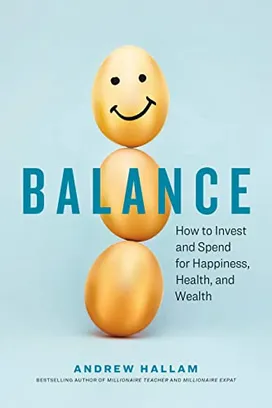
Balance
by Andrew Hallam
Started 25 February 2022 · 240 pages
A personal-finance guide that treats money as one part of a good life, alongside health, relationships and purpose, with advice on investing simply and spending on what matters.
About the book, from Open Library. Get the book.
20 highlights · Kindle location in the margin
- 101
“Happiness will never come to those who fail to appreciate what they already have.” Buddha
- 119
People hope their actions or decisions will make them happy, safe, or secure. In other words, they’re motivated by their life satisfaction.
- 126
there are four quadrants to a successful life: Having enough money Maintaining strong relationships Maximizing your physical and mental health Living with a sense of purpose
- 203
We value our experiences over the things we buy.
- 213
according to Professor Thomas Gilovich and Professor Leaf Van Boven. Their research found that we prefer experiences instead of things because our experiences become part of our identities. As a result, we often think about them later.
- 224
You might even ask yourself, “Years from now, would these purchases make their way into a campfire story?” Most of the time they wouldn’t.
- 256
cars are the greatest personal wealth destroyer. We often borrow to buy them, and they lose value every month.
- 319
Sam Dogen, the man behind the popular blog Financial Samurai, says most people pay far too much for vehicles.
- 322
He has a rule for buying cars that’s seriously countercultural.10 He says nobody should buy a car that costs more than 10 percent of their gross annual income.
- 351
Most people trade time for money. They work at jobs to pay for what they need or want. Material upgrades that don’t provide new experiences (beyond the initial sugar fix) often cost more not only to buy but also to maintain. As a result, people have to work harder to pay for these things—sucking time from their lives.
- 375
So here’s how to test whether a purchase might provide an experience that boosts your happiness or well-being. Ask yourself if it creates experiences you wouldn’t otherwise have.
- 411
If you would still buy a bigger home or renovate your home if nobody outside your live-in family could ever see it, then go for it. But be honest with yourself. Ask yourself if these changes will enhance your overall life satisfaction. In most cases, they won’t.
- 416
The stuff we buy rarely makes us happier. More often, it actually has the opposite effect, whetting our appetites for even more because, for some reason, we think bigger, fancier, or newer things will make us happier.
- 418
instead of buying more, or “better,” stuff, consider spending your money on experiences. You might choose to take dancing, guitar, or cooking lessons. Perhaps you’ll travel somewhere and learn a foreign language. Or maybe you’ll save enough money to take some time away from work. It could be a sabbatical you spend with your family, exploring the country or enjoying a series of activities together. After all, the most important key to living well is having good relationships.
- 443
Jenny G. Olson, an assistant professor of marketing at Indiana University’s Kelley School of Business, and Scott I. Rick, an associate professor of marketing at the University of Michigan’s Ross School of Business, dug in to the dating scene. They wanted to see if singles preferred big spenders or people who were responsible with their money.
- 454
Overwhelmingly, the participants favored savers.
- 471
Material things rarely boost life satisfaction. But if an item provides an experience you couldn’t ordinarily enjoy, especially if it enhances time with your friends, it might be worth the money.
- 476
Spend less money on stuff and more on memorable experiences.
- 480
Before purchasing something, consider the desert island litmus test. Ask yourself, “Would I still buy this if nobody else could see it?”
- 482
Most of the things we buy—and that we don’t really need—offer a short-term sugar high from which we quickly slump. That slump often drives us to then buy something else, and the process repeats itself ad infinitum.