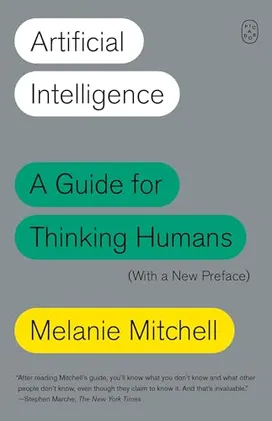
Artificial Intelligence
by Melanie Mitchell
Started 27 July 2021 · 336 pages
A computer scientist explains how today’s AI actually works, what it can and can’t do, and why human-like understanding remains much harder than the hype suggests.
About the book, from Open Library. Get the book.
93 highlights · page in the margin
- p. 5
Written in the 1970s, GEB was an outpouring of Hofstadter’s many intellectual passions—mathematics, art, music, language, humor, and wordplay, all brought together to address the deep questions of how intelligence, consciousness, and the sense of self-awareness that each human experiences so fundamentally can emerge from the non-intelligent, nonconscious substrate of biological cells. It’s also about how intelligence and self-awareness might eventually be attained by computers.
- p. 6
Hofstadter went on.2 He described how, when he first started working on AI in the 1970s, it was an exciting prospect but seemed so far from being realized that there was no “danger on the horizon, no sense of it actually happening.” Creating machines with humanlike intelligence was a profound intellectual adventure, a long-term research project whose fruition, it had been said, lay at least “one hundred Nobel prizes away.”
- p. 7
in practice, until recently, it seemed to Hofstadter that general “human-level” AI had no chance of occurring in his (or even his children’s) lifetime, so he didn’t worry much about it.
- p. 10
In the Google conference room, Hofstadter paused, peering into our faces. No one said a word. At last he went on. “I was terrified by EMI. Terrified. I hated it, and was extremely threatened by it. It was threatening to destroy what I most cherished about humanity. I think EMI was the most quintessential example of the fears that I have about artificial intelligence.”
- p. 10
While Hofstadter strongly doubted the premise of the Singularity, he admitted that Kurzweil’s predictions still disturbed him. “I was terrified by the scenarios. Very skeptical, but at the same time, I thought, maybe their timescale is off, but maybe they’re right. We’ll be completely caught off guard. We’ll think nothing is happening and all of a sudden, before we know it, computers will be smarter than us.” If this actually happens, “we will be superseded. We will be relics. We will be left in the dust. “Maybe this is going to happen, but I don’t want it to happen soon. I don’t want my children to be left in the dust.”
- p. 11
Hofstadter’s terror was in response to something entirely different. It was not about AI becoming too smart, too invasive, too malicious, or even too useful. Instead, he was terrified that intelligence, creativity, emotions, and maybe even consciousness itself would be too easy to produce—that what he valued most in humanity would end up being nothing more than a “bag of tricks,” that a superficial set of brute-force algorithms could explain the human spirit.
- p. 12
“If such minds of infinite subtlety and complexity and emotional depth could be trivialized by a small chip, it would destroy my sense of what humanity is about.”
- p. 13
In 2014, the physicist Stephen Hawking proclaimed, “The development of full artificial intelligence could spell the end of the human race.”7 In the same year, the entrepreneur Elon Musk, founder of the Tesla and SpaceX companies, said that artificial intelligence is probably “our biggest existential threat” and that “with artificial intelligence we are summoning the demon.”8 Microsoft’s cofounder Bill Gates concurred: “I agree with Elon Musk and some others on this and don’t understand why some people are not concerned.”9 The philosopher Nick Bostrom’s book Superintelligence, on the potential dangers of machines becoming smarter than humans, became a surprise bestseller, despite its dry and ponderous style.
- p. 14
This book arose from my attempt to understand the true state of affairs in artificial intelligence—what computers can do now, and what we can expect from them over the next decades.
- p. 14
I look at the extent to which computers can now do things that we believe to require high levels of intelligence—beating humans at the most intellectually demanding games, translating between languages, answering complex questions, navigating vehicles in challenging terrain. And I examine how they fare at the things we take for granted, the everyday tasks we humans perform without conscious thought: recognizing faces and objects in images, understanding spoken language and written text, and using the most basic common sense.
- p. 18
Most people in artificial intelligence trace the field’s official founding to a small workshop in 1956 at Dartmouth College organized by a young mathematician named John McCarthy.
- p. 19
“Define your terms … or we shall never understand one another.”10 This admonition from the eighteenth-century philosopher Voltaire is a challenge for anyone talking about artificial intelligence, because its central notion—intelligence—remains so ill-defined.
- p. 20
As for human intelligence, IQ is measured on a single scale, but we also talk about the different dimensions of intelligence: emotional, verbal, spatial, logical, artistic, social, and so forth.
- p. 20
On the practical side, AI proponents simply want to create computer programs that perform tasks as well as or better than humans, without worrying about whether these programs are actually thinking in the way humans think.
- p. 21
But since the 2010s, one family of AI methods—collectively called deep learning (or deep neural networks)—has risen above the anarchy to become the dominant AI paradigm.
- p. 21
AI is a field that includes a broad set of approaches, with the goal of creating machines with intelligence. Deep learning is only one such approach. Deep learning is itself one method among many in the field of machine learning, a subfield of AI in which machines “learn” from data or from their own “experiences.”
- p. 23
To the computer, the “meaning” of the symbols derives from the ways in which they can be combined, related to one another, and operated on.
- p. 23
symbols. Symbolic AI of the kind illustrated by GPS ended up dominating the field for its first three decades, most notably in the form of expert systems, in which human experts devised rules for computer programs to use in tasks such as medical diagnosis and legal decision-making.
- p. 24
An early example of a subsymbolic, brain-inspired AI program was the perceptron, invented in the late 1950s by the psychologist Frank Rosenblatt.
- p. 24
A neuron is a cell in the brain that receives electrical or chemical input from other neurons that connect to it. Roughly speaking, a neuron sums up all the inputs it receives from other neurons, and if the total sum reaches a certain threshold level, the neuron fires.
- p. 24
Neuroscientists believe that adjustments to the strength of connections between neurons is a key part of how learning takes place in the brain.
- p. 28
Rosenblatt’s idea was that the perceptron should similarly be trained on examples: it should be rewarded when it fires correctly and punished when it errs. This form of conditioning is now known in AI as supervised learning.
- p. 37
In general, it’s hard to know ahead of time how many layers of hidden units are needed, or how many hidden units should be included in a layer, for a network to perform well on a given task. Most neural network researchers use a form of trial and error to find the best settings.
- p. 40
According to the proponents of connectionism, the key to intelligence was an appropriate computational architecture—inspired by the brain—and the ability of the system to learn on its own from data or from acting in the world.
- p. 46
sense. A recent appraisal of the field stated this well: “A pile of narrow intelligences will never add up to a general intelligence. General intelligence isn’t about the number of abilities, but about the integration between those abilities.”
- p. 58
Kurzweil’s thinking has been particularly influential in the tech industry, where people often believe in exponential technological progress as the means to solve all of society’s problems.
- p. 59
Hofstadter has noted Kurzweil’s clever use of what Hofstadter calls the “Christopher Columbus ploy,”38 referring to the Ira Gershwin song “They All Laughed,” which includes the line “They all laughed at Christopher Columbus.”
- p. 60
In 2002, a website called Long Bets was created to help keep futurists honest. Long Bets is “an arena for competitive, accountable predictions,”41 allowing a predictor to make a long-term prediction that specifies a date and a challenger to challenge the prediction, both putting money on a wager that will be paid off after the prediction’s date is passed.
- p. 69
One prerequisite to describing visual input is object recognition—that is, recognizing a particular group of pixels in an image as a particular object category, such as “woman,” “dog,” “balloon,” or “laptop computer.” Object recognition is typically so immediate and effortless for us as humans that it didn’t seem as though it would be a particularly hard problem for computers, until AI researchers actually tried to get computers to do it.
- p. 70
Deep learning simply refers to methods for training “deep neural networks,” which in turn refers to neural networks with more than one hidden layer.
- p. 70
The depth of a network is its number of hidden layers: a “shallow” network—like the one we saw in chapter 2—has only one hidden layer; a “deep” network has more than one hidden layer.
- p. 70
It’s worth emphasizing this definition: the deep in deep learning doesn’t refer to the sophistication of what is learned; it refers only to the depth in layers of the network being trained.
- p. 71
ConvNets are the driving force behind today’s deep-learning revolution in computer vision, and in other areas as well. Although they have been widely heralded as the next big thing in AI, ConvNets are actually not very new: they were first proposed in the 1980s by the French computer scientist Yann LeCun, who had been inspired by Fukushima’s neocognitron.
- p. 77
A ConvNet (like the brain) represents the visual scene as a collection of maps, reflecting the specific “interests” of a set of detectors.
- p. 79
Inspired by Hubel and Wiesel’s findings on the brain’s visual cortex, a ConvNet takes an input image and transforms it—via convolutions—into a set of activation maps with increasingly complex features. The features at the highest convolutional layer are fed into a traditional neural network (which I’ve called the classification module), which outputs confidence percentages for the network’s known object categories. The object category with the highest confidence is returned as the network’s classification of the image.
- p. 91
ConvNets can be applied to video and used in self-driving cars to track pedestrians, or to read lips and classify body language. ConvNets can even diagnose breast and skin cancer from medical images, determine the stage of diabetic retinopathy, and assist physicians in treatment planning for prostate cancer.
- p. 93
When a human says that a photo contains, say, a dog, we assume it’s because the human actually saw a dog in the photo. But if a ConvNet correctly says “dog,” how do we know it actually is basing this classification on the dog in the image? Maybe there’s something else in the image—a tennis ball, a Frisbee, a chewed-up shoe—that was often associated with dogs in the training images, and the ConvNet is recognizing these and assuming there is a dog in the photo. These kinds of correlations have often ended up fooling machines.
- p. 95
the computer-vision expert Ali Farhadi told The New York Times, “We’re still very, very far from visual intelligence, understanding scenes and actions the way humans do.”
- p. 97
While ConvNets use back-propagation to learn their “parameters” (that is, weights) from training examples, this learning is enabled by a collection of what are called “hyperparameters”—an umbrella term that refers to all the aspects of the network that need to be set up by humans to allow learning to even begin. Examples of hyperparameters include the number of layers in the network, the size of the units’ “receptive fields” at each layer, how large the change in each weight should be during learning (called the learning rate), and many other technical details of the training process. This part of setting up a ConvNet is called tuning the hyperparameters.
- p. 98
Because of the open-ended nature of designing these networks, in general it is not possible to automatically set all the parameters and designs, even with automated search. Often it takes a kind of cabalistic knowledge that students of machine learning gain both from their apprenticeships with experts and from hard-won experience.
- p. 98
Membership in the deep-learning club can be quite lucrative. At a recent conference I attended, a leader of Microsoft’s AI product group spoke to the audience about the company’s efforts to hire young deep-learning engineers: “If a kid knows how to train five layers of neural networks, the kid can demand five figures. If the kid knows how to train fifty layers, the kid can demand seven figures.”
- p. 99
when we use services provided by tech companies such as Google, Amazon, and Facebook, we are directly providing these companies with examples—in the form of our images, videos, text, or speech—that they can utilize to better train their AI programs. And these improved programs attract more users (and thus more data), helping advertisers to target their ads more effectively. Moreover, the training examples we provide them can be used to train and offer services such as computer vision and natural-language processing to businesses for a fee.
- p. 99
the reliance on extensive collections of labeled training data is one more way in which deep learning differs from human learning.
- p. 101
AI researcher Andrew Ng has warned, “Requiring so much data is a major limitation of [deep learning] today.”12 Yoshua Bengio, another high-profile AI researcher, agrees: “We can’t realistically label everything in the world and meticulously explain every last detail to the computer.”
- p. 101
This issue is compounded by the so-called long-tail problem: the vast range of possible unexpected situations an AI system could be faced with.
- p. 102
The term long tail comes from statistics, in which certain probability distributions are shaped like the one in figure 13: the long list of very unlikely (but possible) situations is called the “tail” of the distribution. (The situations in the tail are sometimes called edge cases.)
- p. 103
The term unsupervised learning refers to a broad group of methods for learning categories or actions without labeled data. Examples include methods for clustering examples based on their similarity or learning a new category via analogy to known categories.
- p. 103
perceiving abstract similarity and analogies is something at which humans excel, but to date there are no very successful AI methods for this kind of unsupervised learning.
- p. 103
for general AI, almost all learning will have to be unsupervised, but no one has yet come up with the kinds of algorithms needed to perform successful unsupervised learning.
- p. 104
humans also have a fundamental competence lacking in all current AI systems: common sense. We have vast background knowledge of the world, both its physical and its social aspects. We have a good sense of how objects—both inanimate and living—are likely to behave, and we use this knowledge extensively in making decisions about how to act in any given situation.
- p. 104
Many people believe that until AI systems have common sense as humans do, we won’t be able to trust them to be fully autonomous in complex real-world situations.
- p. 104
A few years ago, Will Landecker, then a graduate student in my research group, trained a deep neural network to classify photographs into one of two categories: “contains an animal” and “does not contain an animal.” The network was trained on photos like the ones in figure 15, and it performed very well on this task on the test set. But what did the network actually learn? By performing a careful study, Will found an unexpected answer: in part, the network learned to classify images with blurry backgrounds as “contains an animal,” whether or not the image actually contained an animal.14 The nature photos in the training and test sets obeyed an important rule of photography: focus on the subject of the photo. When the subject of the photo is an animal, the animal is the focus and the background is blurred, as in figure 15A. When the subject of the photo is the background, as in figure 15B, nothing is blurred. To Will’s chagrin, his network hadn’t learned to recognize animals; instead, it used simpler cues—such as blurry backgrounds—that were statistically associated with animals.
- p. 107
Commercial face-recognition systems, for example, tend to be more accurate on white male faces than on female or nonwhite faces.
- p. 107
these biases in AI training data reflect biases in our society, but the spread of real-world AI systems trained on biased data can magnify these biases and do real damage.
- p. 107
Face-recognition systems, for example, are increasingly being deployed as a “secure” way to identify people in credit-card transactions, airport screening, and security cameras, and it may be only a matter of time before they are used to verify identity in voting systems, among other applications. Even small differences in accuracy between racial groups can have damaging repercussions in civil rights and access to vital services.
- p. 108
“showing their work” is something that deep neural networks—the bedrock of modern AI systems—cannot easily do.
- p. 109
MIT’s Technology Review magazine called this impenetrability “the dark secret at the heart of AI.”19 The fear is that if we don’t understand how AI systems work, we can’t really trust them or predict the circumstances under which they will make errors.
- p. 109
you trust other people when you believe that their thinking is like your own. You assume, most often, that other humans you encounter have had sufficiently similar life experiences to your own, and thus you assume they are using the same basic background knowledge, beliefs, and values that you do in perceiving, describing, and making decisions about the world.
- p. 109
where other people are concerned, you have what psychologists call a theory of mind—a model of the other person’s knowledge and goals in particular situations. None of us have a similar “theory of mind” for AI systems such as deep networks, which makes it harder to trust them.
- p. 109
one of the hottest new areas of AI is variously called “explainable AI,” “transparent AI,” or “interpretable machine learning.”
- p. 111
group from the University of Wyoming published an article with a more direct title: “Deep Neural Networks Are Easily Fooled.”21 By using a biologically inspired computational method called genetic algorithms,22 the Wyoming group was able to computationally “evolve” images that look like random noise to humans but for which AlexNet and other convolutional neural networks assigned specific object categories with greater than 99 percent confidence.
- p. 113
Adversarial-learning researchers often start their work by demonstrating possible ways in which existing systems can be attacked, and some of the recent demonstrations have been stunning. In the domain of computer vision, one group of researchers developed a program that could create eyeglass frames with specific patterns that fool a face-recognition system into confidently misclassifying the wearer as another person (figure 20).24 Another group developed small, inconspicuous stickers that could be placed on a traffic sign, resulting in a ConvNet-based vision system—similar to those used in self-driving cars—to misclassify the sign (for example, a stop sign is classified as a speed-limit sign).25 Yet another group demonstrated a possible adversarial attack on deep neural networks for medical image analysis: they showed that it is not hard to alter an X-ray or microscopy image in a way that is imperceptible to humans but that causes a network to change its classification from, say, 99 percent confidence that the image shows no cancer to 99 percent confidence that cancer is present.
- p. 114
are we fooling ourselves when we think these networks have actually learned the concepts we are trying to teach them?
- p. 114
To my mind, the ultimate problem is one of understanding
- p. 114
Even though AlexNet performs very well on ImageNet, we humans understand many things about the objects we see that are unknown to AlexNet or any other current AI system. We know what objects look like in three dimensions and can imagine this from a two-dimensional photo. We know what the function of a given object is, what role the object’s parts play in its overall function, and in what contexts an object usually appears. Seeing an object brings up memories of seeing such objects in other circumstances, from other viewpoints, as well as in other sensory modalities (we remember what a given object feels like, smells like, perhaps what it sounds like when dropped, and so on). All of this background knowledge feeds into the human ability to robustly recognize a given object. Even the most successful AI vision systems lack this kind of understanding and the robustness that it confers.
- p. 115
Jeff Clune, an AI researcher at the University of Wyoming, made a very provocative analogy when he noted that there is “a lot of interest in whether Deep Learning is ‘real intelligence’ or a ‘Clever Hans.’”
- p. 116
Clever Hans has become a metaphor for any individual (or program!) that gives the appearance of understanding but is actually responding to unintentional cues given by a trainer.
- p. 118
Automated vehicles could substantially reduce the millions of annual deaths and injuries due to auto accidents, many of them caused by intoxicated or distracted drivers. In addition, automated vehicles would allow their human passengers to be productive rather than idle during commute times. These vehicles also have the potential to be more energy efficient than cars with human drivers and will be a godsend for blind or handicapped people who can’t drive. But all this will come to pass only if we humans are willing to trust these vehicles with our lives.
- p. 122
Amazon, for example, markets its face-recognition system (with the strangely dystopian-sounding name Rekognition) to police departments, which can compare, say, security-camera footage with a database of known offenders or likely suspects.
- p. 125
Such uncertainties will no doubt ensure gainful employment for policy makers and lawyers for a long time to come.
- p. 125
My own opinion is that too much attention has been given to the risks from superintelligent AI and far too little to deep learning’s lack of reliability and transparency and its vulnerability to attacks.
- p. 126
Probably the best-known discussion of machine morality comes from Isaac Asimov’s science fiction stories, in which he proposed the three “fundamental Rules of Robotics”: 1. A robot may not injure a human being, or, through inaction, allow a human being to come to harm. 2. A robot must obey the orders given to it by human beings except where such orders would conflict with the First Law. 3. A robot must protect its own existence, as long as such protection does not conflict with the First or Second Law.15
- p. 127
The trolley problem has recently reemerged as part of the media’s coverage of self-driving cars,20 and the question of how an autonomous vehicle should be programmed to deal with such problems has become a central talking point in discussions on AI ethics.
- p. 133
When the journalist Amy Sutherland was doing research for a book on exotic animal trainers, she learned that their primary method is preposterously simple: “reward behavior I like and ignore behavior I don’t.”
- p. 133
“Eventually it hit me that the same techniques might work on that stubborn but lovable species, the American husband.”
- p. 133
This classic training technique, known in psychology as operant conditioning, has been used for centuries on animals and humans.
- p. 133
Operant conditioning inspired an important machine-learning approach called reinforcement learning. Reinforcement learning contrasts with the supervised-learning method I’ve described in previous chapters: in its purest form, reinforcement learning requires no labeled training examples. Instead, an agent—the learning program—performs actions in an environment (usually a computer simulation) and occasionally receives rewards from the environment.
- p. 138
In humans, this kind of behavior might be called superstition—namely, erroneously believing that a particular action can help cause a particular good or bad outcome. In reinforcement learning, superstition is something that you have to be careful to avoid.
- p. 139
Rosie keeps track of the values of actions in a big table in her computer memory.
- p. 139
This table of states, actions, and values is called the Q-table. This form of reinforcement learning is sometimes called Q-learning.
- p. 142
Deciding how much to explore new actions and how much to exploit (that is, stick with) tried-and-true actions is called the exploration versus exploitation balance. Achieving the right balance is a core issue for making reinforcement learning successful.
- p. 147
Breakout was the result of Atari’s effort to create a single-player version of its successful game Pong. The design and implementation of Breakout were originally assigned in 1975 to a twenty-year-old employee named Steve Jobs. Yes, that Steve Jobs (later, cofounder of Apple). Jobs lacked sufficient engineering skills to do a good job on Breakout, so he enlisted his friend Steve Wozniak, aged twenty-five (later, the other cofounder of Apple), to help on the project. Wozniak and Jobs completed the hardware design of Breakout in four nights, starting work each night after Wozniak had completed his day job at Hewlett-Packard. Once released, Breakout, like Pong, was hugely popular among gamers.
- p. 166
AlphaGo (in all its versions) can’t play anything but Go. Even the most general version, AlphaZero, is not a single system that learned to play Go, chess, and shogi. Each game has its own separate convolutional neural network that must be trained from scratch for its particular game. Unlike humans, none of these programs can “transfer” anything it has learned about one game to help it learn a different game.
- p. 166
A hopeful phrase in the machine-learning community is “transfer learning,” which refers to the ability of a program to transfer what it has learned about one task to help it perform a different, related task. For humans, transfer learning is automatic.
- p. 166
Humans exhibit this kind of transfer from one task to another seemingly effortlessly; our ability to generalize what we learn is a core part of what it means for us to think.
- p. 170
while these deep Q-learning systems have achieved superhuman performance in some narrow domains, and even exhibit what resembles “intuition” in these domains, they are lacking something absolutely fundamental to human intelligence. Whether it is called abstraction, domain generalization, or transfer learning, imbuing systems with this ability is still one of AI’s most important open problems.
- p. 171
For humans, a crucial part of intelligence is, rather than being able to learn any particular skill, being able to learn to think and to then apply our thinking flexibly to whatever situations or challenges we encounter. This is the true skill we want our children to learn when they play chess or Go.
- p. 172
Douglas Hofstadter has pointed out that the very notion of a clearly defined “state” isn’t at all realistic. “If you look at situations in the world, they don’t come framed, like a chess game or a Go game.… A situation in the world is something that has no boundaries at all; you don’t know what’s in the situation, what’s out of the situation.”
- p. 173
All these issues led Andrej Karpathy, Tesla’s director of AI, to note that, for real-world tasks like this, “basically every single assumption that Go satisfies and that AlphaGo takes advantage of are violated, and any successful approach would look extremely different.”
- p. 181
What’s stunning to me is that speech-recognition systems are accomplishing all this without any understanding of the meaning of the speech they are transcribing. While the speech-recognition system on my phone can transcribe every word of my “Restaurant” story, I guarantee you that it doesn’t understand a thing about it, or about anything else.
- p. 181
There’s a famous rule of thumb in any complex engineering project: the first 90 percent of the project takes 10 percent of the time and the last 10 percent takes 90 percent of the time. I think that some version of this rule applies in many AI domains (hello, self-driving cars!) and will end up being true in speech recognition as well. The last 10 percent includes dealing not only with noise, unfamiliar accents, and unknown words but also with the fact that the ambiguity and context sensitivity of language can impinge on interpreting speech.
- p. 183
Furthermore, there have been several efforts, with varying success, to apply “sentiment mining” of, say, economics-related tweets on Twitter to predict stock prices and election outcomes.
- p. 188
All of these methods are based on the same idea, which was expressed beautifully by the linguist John Firth in 1957: “You shall know a word by the company it keeps.”10 That is, the meaning of a word can be defined in terms of other words it tends to occur with, and the words that tend to occur with those words, and so on.